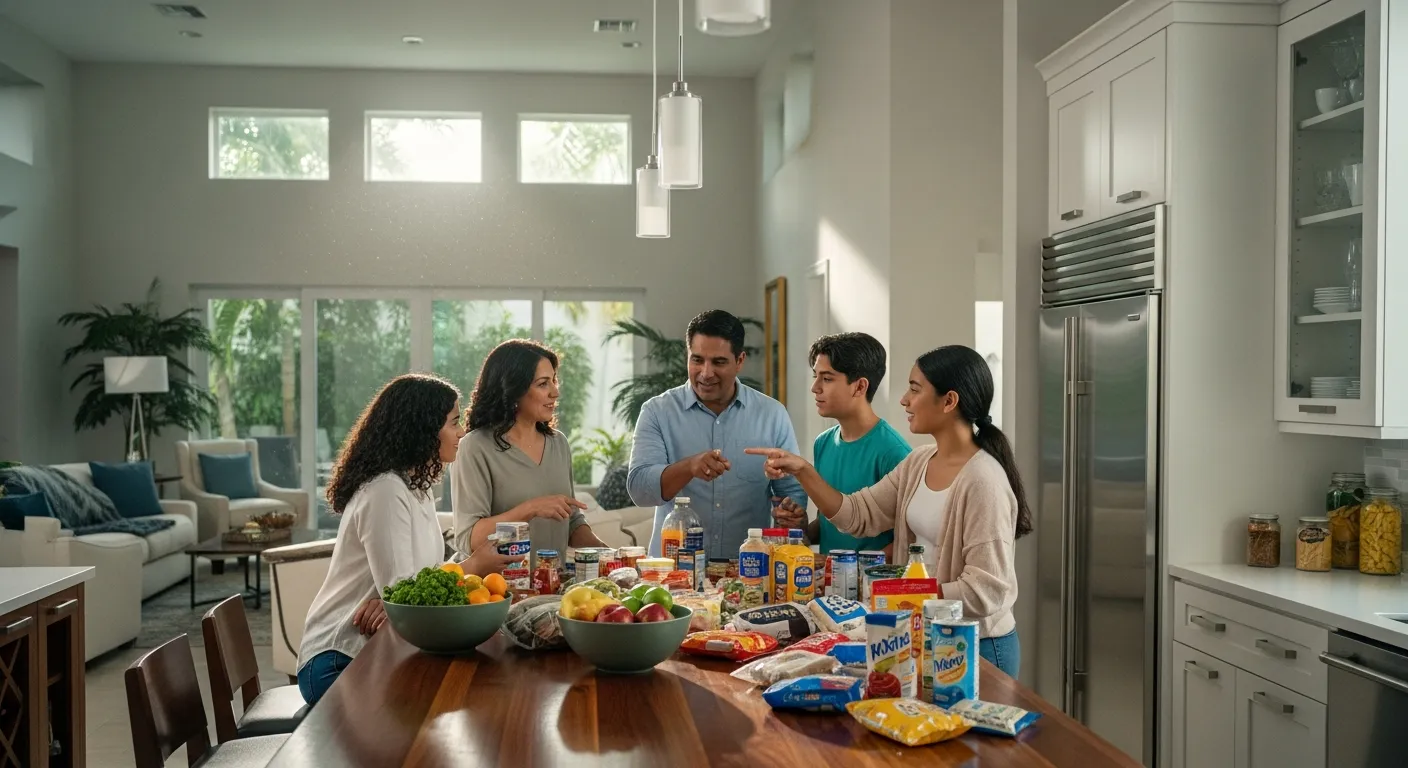
In-Home Tests Miami
In-home use tests (IHUT), pantry audits, and ethnographic home visits with Venezuelan, Cuban, Colombian, and Caribbean diaspora households across Miami-Dade, Broward, and Palm Beach. Bilingual field teams. Fixed-price quotes in 24 to 48 hours, depending on complexity.
Why In-Home Research Matters in Miami's Hispanic Market
A focus group facility in Doral tells you what a Venezuelan consumer thinks about a product. An in-home visit to a Venezuelan household in Doral tells you what they actually do with it. These are not the same thing.
South Florida's Hispanic households have distinct pantry architectures, cooking routines, and product use patterns shaped by national origin, migration history, and acculturation level. A Colombian household in Weston buys Zenú luncheon meat from the Latin supermarket and Boar's Head from Publix -- and uses them for different occasions. A Cuban household in Hialeah has a specific rotation of café preparation rituals that no focus group stimulus can fully replicate. A Haitian household in Miramar uses a different set of cooking fats, spices, and preparation methods than any other Miami community.
These details matter for product development, packaging design, serving suggestion copy, and trade channel strategy. They are only reliably accessible through in-home research.
In-Home Research Methods: What HRG Offers
| Method | Description | Typical Sample |
|---|---|---|
| In-home use test (IHUT) | Product placed with households for 1-2 weeks; structured diary and post-use survey | 20-50 households, community-segmented |
| Pantry audit | 90-minute home visit; photographic catalogue of pantry, fridge, storage areas; structured debrief | 10-20 households, 2-3 community segments |
| Ethnographic home visit | Observed 2-3 hour session: cooking, shopping, product selection; open-ended discovery | 8-12 households per segment |
| Shop-along | Researcher accompanies participant through retail trip; observations + debrief | 10-15 participants, target store formats |
| Video diary IHUT | Household self-records product use via smartphone app; structured prompts over 7-14 days | 20-40 households, bilingual prompts |
Community Coverage for In-Home Tests in Miami
| Community | Primary Location | Key IHUT Categories |
|---|---|---|
| Venezuelan | Doral, Weston, Brickell | Food staples, beverages, household products, personal care |
| Cuban-American | Hialeah, Little Havana, Westchester | Coffee, food staples, personal care, beer and rum |
| Colombian | Weston, Doral, Pembroke Pines | Dairy, packaged foods, personal care, beverages |
| Nicaraguan | Sweetwater, Kendall, Fountainebleau | Staple foods, household products, remittance services |
| Puerto Rican | Broward County, Orlando corridor | Food, beverages, quick service restaurant evaluation |
| Haitian | Miramar, North Miami, Little Haiti | Food staples, personal care, financial services |
| Jamaican | Lauderhill, Miramar, Plantation | Food, beverages, personal care, financial services |
In-Home Test Pricing in Miami
| Study Type | Sample | Indicative Price |
|---|---|---|
| Standard IHUT | 30 households, 1 community segment, 1-week placement | USD 18,000 to USD 22,000 |
| Multi-community IHUT | 40 households, 2-3 community segments, cross-analysis | USD 24,000 to USD 32,000 |
| Pantry audit | 15 households, photographic catalogue + debrief report | USD 6,000 to USD 9,000 |
| Ethnographic visits | 10 households, 2-3 hour observed session per home | USD 12,000 to USD 16,000 |
| Shop-along programme | 12 participants, 2 store formats | USD 8,000 to USD 12,000 |
Prices include recruitment, bilingual field staff, incentives, and a written debrief report. Contact HRG for a fixed-price project proposal.
Get a Quote for Miami In-Home Research
Discover which research methodology best fits your Caribbean market entry strategy.
Related Services
- Focus Groups Miami - bilingual group discussions across South Florida
- In-Depth Interviews Miami - one-on-one bilingual IDIs for sensitive topics
- Venezuelan Consumer Research Miami - IHUT and pantry studies in Doral
- Cuban Consumer Research Miami - in-home studies with Cuban-American households
- Caribbean Community Research Miami - Jamaican, Haitian, Trinidadian in-home research
- Shopper Research Caribbean - shopper insight methodology overview
- Focus Groups South Florida - full tri-county qualitative research
- Beverage Market Research - IHUT applications for food and beverage brands
Frequently Asked Questions
What is an in-home use test (IHUT) and why is it valuable with Miami Hispanic consumers?
An in-home use test (IHUT) places a product with consumer households for 1-2 weeks and collects structured feedback on how they actually use the product in their real home environment, rather than in a facility. For Miami Hispanic consumers, IHUTs reveal usage behaviours, preparation methods, pantry integration, and product performance under real household conditions that differ substantially from general US market norms. A Venezuelan household in Doral may use a cooking product in ways that a Colombian household in Weston does not, and neither uses it the way a non-Hispanic US household does.
What is a pantry audit and what does it reveal?
A pantry audit is a structured in-home visit where a trained field researcher photographs and catalogues the contents of a household's pantry, refrigerator, and food storage. In Miami Hispanic households, pantry audits reveal the mix of Latin American heritage brands (Goya, Harina Pan, Polar, Maggi, Knorr Suiza) alongside US mainstream brands, the role of Latin supermarkets versus Publix or Walmart in household sourcing, and category-by-category brand loyalty patterns. Pantry audits are frequently used before in-home product placement studies to establish baseline brand presence.
What communities do you work with for in-home tests in Miami?
HRG conducts in-home tests with Venezuelan households in Doral, Cuban-American households in Hialeah and Westchester, Colombian households in Weston and Doral, Nicaraguan and Central American households in Miami-Dade, Puerto Rican households in Broward, and Caribbean diaspora households (Jamaican, Haitian, Trinidadian) in Broward County. Each community has distinct pantry profiles, cooking habits, product use patterns, and incentive preferences that shape IHUT design.
How much does an in-home use test cost in Miami?
A standard 30-household IHUT in Miami covering product placement, a 1-week in-home period, post-use structured diary or survey, and a brief debrief visit typically runs USD 18,000 to USD 28,000 depending on product category, household targeting difficulty, and deliverables. Pantry audits as standalone studies (10-20 households, 90-minute visit, full photographic catalogue and debrief report) run USD 6,000 to USD 10,000. Contact HRG for a project-specific fixed-price quote.
What is the difference between an IHUT and an ethnographic home visit?
An IHUT places a product with households for a defined period and collects structured usage feedback. An ethnographic home visit is an observed, open-ended session where a researcher accompanies a household member through their normal routines -- cooking, shopping, product selection -- and documents behaviours without a product-specific brief. Ethnographic visits are used for early-stage category understanding, to map the decision journey before a product brief is developed. HRG offers both, often combining an ethnographic baseline with a subsequent IHUT for product testing.
How do you recruit households for in-home tests in Miami?
HRG recruits IHUT households through our pre-qualified South Florida panel, built through community-based recruitment, bilingual community networks, and direct neighbourhood outreach in target areas including Doral, Hialeah, Miramar, and Pembroke Pines across Miami-Dade, Broward, and Palm Beach. Screeners capture household composition, country of origin, product category usage, income band, and home ownership to match the client target profile. Typical recruitment for 30 households takes 7-10 business days.
Download: IHUT Design Guide for South Florida Hispanic Consumers
How to design, recruit, field, and analyse in-home use tests with Venezuelan, Cuban, Colombian, and Caribbean diaspora households in South Florida. Includes community-specific design considerations and pantry audit protocol.