Caribbean Real Estate Market Trends 2025
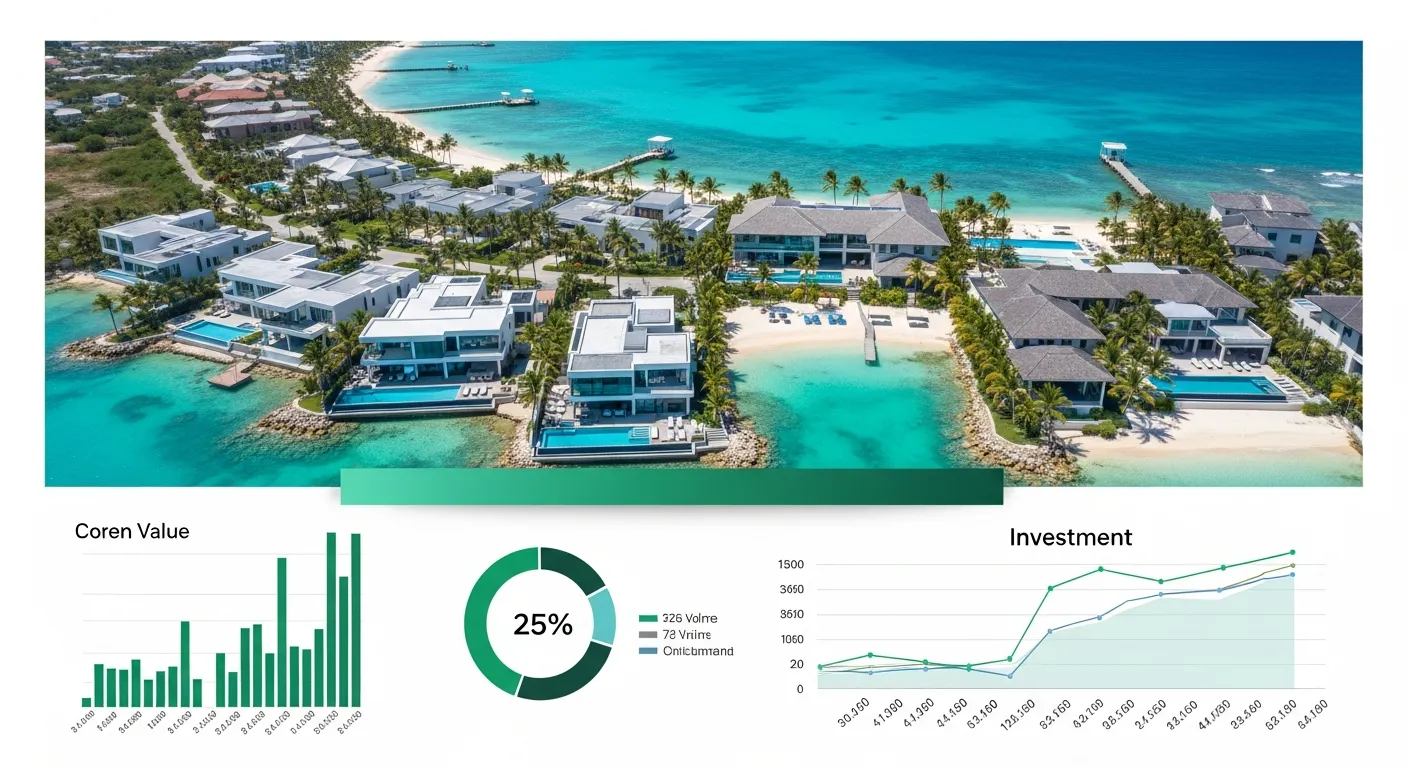
Caribbean prime residential values have risen 27% over the past five years, according to Savills, and the pace of high-value transaction growth is accelerating in 2025 across the region's most sought-after markets. The Cayman Islands surpassed USD 1.021 billion in total real estate sales in 2024, a 7% increase from the prior year, with average West Bay Beach North properties priced at USD 6.76 million (Caribbean World Real Estate, 2025; ERA Cayman, 2024). The Bahamas recorded a 54% year-over-year surge in home sales in the fourth quarter of 2024, driven by a record-breaking tourism season and by a demographic shift that is seeing younger high-net-worth individuals establish primary or secondary residences rather than simply buying vacation properties (World Property Journal, 2025). Barbados average property prices grew 6.8% year-over-year, with Airbnb occupancy reaching 85% during peak season. Yet this headline story of luxury demand coexists with a fundamentally different market reality for domestic buyers: in Jamaica, a 500-square-foot Kingston studio apartment was listed at J$18 million in 2024, a price that is beyond the reach of the majority of Jamaican wage earners and that encapsulates the affordability crisis reshaping residential demand patterns across the region.
Caribbean Real Estate Market: Key Statistics 2024 to 2025
27%
Rise in Caribbean prime residential values over the past five years (Savills, 2025)
$1.02B
Cayman Islands total real estate sales in 2024, up 7% from 2023 (Caribbean World Real Estate, 2025)
54%
Year-over-year increase in Bahamas home sales in Q4 2024 (World Property Journal, 2025)
6.8%
Barbados average property price increase year-over-year, with 85% Airbnb peak occupancy (Caribbean World Real Estate, 2025)
4,822
New Jamaica mortgage accounts in 2024, worth J$82.9 billion, up 12.8% year-on-year (Jamaica Homes, 2025)
800K
Airbnb guests in Jamaica in 2024, up from 59,500 in 2017, generating J$32 billion for hosts (Global Property Guide, 2025)
Caribbean Prime Residential Value Index, 2020-2024
Loading chart...
What Is Driving Caribbean Real Estate Demand in 2025
Caribbean real estate demand in 2025 is being shaped by four structural forces that operate simultaneously across different buyer segments and market tiers.
Tax efficiency is the primary driver for the high-net-worth buyer segment. The Bahamas imposes no income, capital gains, or inheritance taxes. The Cayman Islands offers zero income, property, and capital gains tax. These positions have become significantly more commercially relevant following the UK's 2024 overhaul of non-domiciled tax status and Canada's increase in capital gains taxation, both of which have triggered portfolio and residency restructuring among high-net-worth individuals in those markets. The proportion of wealthy expatriates in the Bahamas holding permanent residency has grown to approximately half of the expatriate community, up from approximately 20% before the pandemic, reflecting the transition from vacation buyer to tax-resident investor (IMGlobal Wealth, 2025). This demographic shift is consequential: a buyer who holds permanent residency has fundamentally different consumption patterns, political engagement, and long-term economic impact than a buyer who visits for a few weeks per year.
Lifestyle diversification and remote work normalisation have expanded the Caribbean buyer base to include younger professionals and entrepreneurs who can maintain career productivity from island settings. This cohort, typically in their thirties and forties, is driving demand for properties with reliable high-speed internet, co-working amenities, and wellness facilities alongside traditional beach and pool features. Turks and Caicos is explicitly marketed on high-infrastructure connectivity grounds, with reliable internet positioned as a core differentiator rather than simply an amenity. The pandemic-era realization that geography no longer constrains productivity for knowledge workers has proven durable, sustaining demand from buyers who would previously have considered Caribbean property only as a retirement or vacation investment.
Tourism-driven short-term rental income has become a fundamental investment thesis for many Caribbean property buyers. Jamaica's Airbnb guest count grew from 59,500 in 2017 to over 800,000 in 2024, generating more than J$32 billion in earnings for hosts. This growth has expanded the short-term rental market beyond traditional North Coast tourist hubs into Kingston, Portland, St Elizabeth, and other parishes that were previously less accessible to the vacation rental market (Global Property Guide, 2025). Barbados Airbnb occupancy reaches 85% during peak seasons, generating gross rental yields that can approach 8% annually in well-located properties (Caribbean World Real Estate, 2025). For investors seeking both capital appreciation and income generation, the convergence of rising tourism arrivals and digital rental platform infrastructure creates an accessible pathway to property monetisation that did not exist at scale a decade ago.
Diaspora capital is the fourth structural demand driver, particularly relevant for Jamaica, Trinidad and Tobago, Guyana, and Barbados. Remittance inflows to Jamaica reached approximately USD 7.4 billion in 2024, and property investment is one of the most common destinations for diaspora savings alongside education and business investment. The analysis of Jamaica's high-value property market shows that many of the transactions involving properties worth J$60 million or more involve Jamaicans based abroad returning capital to their home market, with diaspora buyers providing both purchasing power and market confidence that reinforces sentiment among domestic buyers (Jamaica Homes, 2025).
Market by Market: The Caribbean Property Landscape in 2025
Caribbean Real Estate Sales by Market, 2024 (US$ Millions)
Loading chart...
Cayman Islands
The Cayman Islands is the Caribbean's highest-value real estate market by total transaction volume and average price. The market surpassed USD 1.021 billion in sales in 2024, a 7% increase from 2023, with 858 transactions representing an 18.3% rise in volume from the prior year and properties selling for an average of 94% of listed price, indicating strong and consistent buyer demand relative to seller expectations (Caribbean World Real Estate, 2025; ERA Cayman, 2024). In Q1 2025, the market held 1,368 residential listings worth over USD 2.85 billion, with condominiums generating USD 411.9 million and single-family homes contributing USD 284 million. West Bay Beach North properties averaged USD 6.76 million, and George Town commercial listings averaged USD 6.16 million.
The pipeline of major new supply in the Cayman Islands is significant. The Grand Hyatt is expected to open in 2025, the Hilton Curio and Lacovia developments are generating strong presale interest, and the Mandarin Oriental project has been relaunched. These branded residences and resort-managed condominiums attract buyers who prioritise professional property management and hospitality-grade amenities alongside investment credentials. Zero income, capital gains, and property taxes, combined with the Cayman Islands' position as a premier global financial centre, make the market uniquely compelling for high-net-worth international buyers who may also conduct financial services business through the jurisdiction.
The Bahamas
The Bahamas recorded a 54% year-over-year increase in home sales in Q4 2024, following a record-breaking tourism season that converted visitor experiences into purchase intent at an unusually high rate (World Property Journal, 2025). The shift from buyer's to seller's market in the luxury segment has been driven by inventory shortages in prime beachfront locations, particularly on New Providence and Paradise Island. Luxury developments including Ocean Club and Rosewood Residences at Baha Mar are targeting the USD 1 million to USD 5 million condominium range, responding to a buyer preference for lower-maintenance properties relative to standalone villas while delivering equivalent resort amenity access and hurricane-resilient construction standards.
Major cruise infrastructure investment is reshaping parts of the Bahamas that were previously less integrated into the luxury property market. MSC Cruises' Ocean Cay, Royal Caribbean's CocoCay, and Carnival Corporation's upcoming Celebration Key on Grand Bahama Island, expected to host 4 million guests annually by 2028, are creating new demand nodes for nearby residential and hospitality development (Caribbean World Real Estate, 2025). The proximity to Florida makes the Bahamas particularly accessible for US buyers, and the tax-residency proposition has become more actively marketed as wealth tax discussions intensify in North American policy debates.
Barbados
Barbados average property prices increased 6.8% year-over-year in 2024, with St James and Christ Church posting the strongest demand from international buyers arriving primarily from the UK, Canada, and the US (Caribbean World Real Estate, 2025). The West Coast, known as the Platinum Coast, anchors the ultra-luxury segment, with beachfront properties starting above USD 1 million. Limited prime land supply on the island's west coast has intensified competition: the ultra-wealthy are acquiring existing properties to demolish and rebuild to custom specification, reflecting long-term commitment rather than speculative purchasing. Airbnb occupancy rates reaching 85% during peak season translate to rental yield potential of up to 8% annually for well-managed short-term rental properties, creating a compelling investment case for buyers who plan to rent when not in residence.
Barbados occupies a distinct position in the Caribbean luxury market because its culture, arts scene, cricket heritage, and established expatriate community create lifestyle depth that pure beach destinations cannot match. This cultural richness attracts a buyer cohort that values long-term integration with the island community alongside property investment returns, supporting more stable demand than markets that depend primarily on vacation utility.
Jamaica
Jamaica's residential real estate market is bifurcated between a strong luxury and resort-area segment and a constrained mid-tier and affordable segment where affordability is the defining market dynamic. Kingston's elite enclaves of Norbrook, Cherry Gardens, and Liguanea show no price softening, while Montego Bay's coastal developments near Rose Hall continue to attract US-dollar-denominated premiums from international buyers. Properties qualifying as high-value, those transacting at J$60 million or more, increased approximately eightfold between 2015 and 2024, with over 160 such sales recorded in 2024 (Jamaica Homes, 2025).
The mortgage market showed genuine strength: 4,822 new mortgage accounts worth J$82.9 billion were opened in 2024, up 12.8% year-on-year, even as interest rates remained elevated with the Bank of Jamaica policy rate at 5.75% and mortgage rates averaging 7.5% to 8% depending on lender (Jamaica Homes, 2025). The National Housing Trust provides low-interest mortgage support for eligible Jamaicans, with its loan receivable portfolio standing at J$278.8 billion at the end of financial year 2023 to 2024. The NHT and private mortgage market combined represent a stock estimated at approximately 24% of GDP, indicating the institutional scale of the housing finance sector even against the backdrop of affordability constraints.
Jamaica's short-term rental market transformation is one of the most significant structural changes in the island's real estate landscape over the past decade. Airbnb guests grew from 59,500 in 2017 to over 800,000 in 2024, with J$32 billion in earnings flowing to hosts across the island. This growth has spread from traditional Montego Bay and Ocho Rios concentrations into Kingston, Portland, Negril, and smaller communities, effectively democratising tourism participation for property owners who previously had no viable short-term rental channel (Global Property Guide, 2025). The July 2025 AirDNA data shows Kingston as the market with the largest number of active listings and the highest average occupancy, confirming that business travel and events tourism has established a viable urban short-term rental market alongside the traditional leisure market.
Jamaica Airbnb Guest Growth, 2017-2024 (Millions)
Loading chart...
Free Caribbean Market Assessment
Discover which research methodology best fits your Caribbean market entry strategy.
Caribbean Real Estate Market Comparison 2024 to 2025
| Market | 2024 Headline | Primary Buyer Profile | Tax Position | Rental Yield |
|---|---|---|---|---|
| Cayman Islands | $1.021B total sales, 7% growth; 858 transactions (18.3% increase) | HNWI and financial sector professionals; tax-residency seekers | Zero income, capital gains, property tax | 3 to 5% average; luxury segment varies |
| Bahamas | 54% surge in Q4 2024 home sales; seller's market in luxury segment | US and Canadian HNWIs; permanent residency seekers; 50% now hold PR | No income, capital gains, or inheritance taxes | 3 to 5%; higher in resort-managed properties |
| Barbados | 6.8% average price growth; 85% peak Airbnb occupancy | UK, Canadian, and US buyers; long-term cultural lifestyle investors | No capital gains tax; favourable ownership laws | Up to 8% in peak STR periods |
| Jamaica | 4,822 new mortgages J$82.9B; 800K Airbnb guests; luxury up 8x in decade | Diaspora buyers; resort developers; domestic mid-income (constrained) | Standard income and property taxes apply | 6.39% gross yield Kingston; STR yields up to 8% in resort areas |
| Antigua and Barbuda | 739 CBI real estate applications H1 2024, 8% increase; 60% UK buyers | CBI passport seekers; UK buyers; luxury beachfront investors | Favourable tax environment; ALHL required for non-CBI foreign buyers | 3 to 5% in approved CBI projects |
| Dominican Republic | Cap Cana developments from USD 239K; TotalEnergies renewable energy investment driving infrastructure confidence | International investors, North American retirees, resort developers | Standard taxes; tax incentives in tourism development zones | 5 to 8% in Cap Cana and Punta Cana resort corridor |
Citizenship by Investment: The Caribbean's Global Mobility Premium
Five Caribbean countries operate citizenship by investment programmes that allow foreign nationals to obtain second citizenship through qualifying real estate purchases, making the Caribbean the most concentrated region globally for CBI access through property. The programmes are a significant driver of foreign direct investment, often accounting for the majority of new beachfront and resort-area residential development activity in participating jurisdictions.
Caribbean Citizenship by Investment: Minimum Real Estate Thresholds
Loading chart...
Antigua and Barbuda's programme is experiencing strong momentum, with 739 real estate investment applications submitted in the first half of 2024, an 8% increase from the prior year period. British buyers constitute 60% of foreign property purchases, reflecting both the historical relationship and the growing appeal of Caribbean tax residency as an alternative for UK high-net-worth individuals following non-domicile tax reform (Caribbean World Real Estate, 2025). The minimum qualifying real estate investment is USD 200,000 for a jointly purchased approved property.
St Kitts and Nevis is often cited as offering the fastest CBI passport processing in the Caribbean, with approximately 70% of all real estate transactions in the country conducted within the CBI framework. Minimum qualifying investment is USD 325,000 for joint ownership and USD 600,000 for sole ownership in approved developments. The St Kitts and Nevis passport provides visa-free or visa-on-arrival access to over 160 countries. Grenada's CBI programme is unique in providing a route to US E-2 Treaty Investor visa eligibility, making it particularly attractive to buyers seeking eventual US access who cannot qualify through other pathways. The minimum qualifying investment is USD 270,000. St Lucia and Dominica complete the five-country CBI landscape, with minimum real estate thresholds of USD 300,000 and USD 200,000 respectively. All CBI programmes require investment in government-approved projects with minimum holding periods of three to seven years and verification of source of funds (Global Citizen Solutions, 2024).
Short-Term Rentals and the Platformisation of Caribbean Property Income
The normalisation of short-term rental platforms as a property income channel has restructured the economics of Caribbean property investment for a broad spectrum of owners. Jamaica's Airbnb guest count growing from 59,500 in 2017 to over 800,000 in 2024 represents a 13-fold increase in platform-mediated tourist accommodation demand. This growth has generated J$32 billion in earnings distributed across host properties throughout the island, effectively converting individual homeowners and property investors into micro-hospitality operators (Global Property Guide, 2025).
The financial dynamics of short-term rental economics in the Caribbean are attractive relative to long-term lease alternatives. In Jamaica, long-term rental yields in Kingston average approximately 6.39% on a gross basis, with rents for one-bedroom units at approximately USD 950 per month and two-bedroom units at USD 1,500 per month (Global Property Guide, 2025). Short-term rental yields in resort areas can approach 8% annually at sustained occupancy, and seasonal peak yields can reach 9% to 10% monthly during high season. The growing preference of Jamaican landlords for short-term rental formats over long-term tenancy is documented: with annual increases on long-term contracts capped by law and asking rents for new tenants growing consistently, many landlords now offer shorter monthly contracts or convert entirely to holiday rental formats.
The social and policy implications of short-term rental growth are generating regulatory attention. An estimated 30% of business previously going to small and medium-sized hotel operators in Jamaica is now being captured by short-term rental listing platforms, creating tension between the hospitality industry and property owners who are accessing the same tourist demand through platforms rather than regulated hotel channels. The lack of standardised regulation for short-term rentals in Jamaica and across much of the Caribbean means that quality standards, tax collection, and environmental impact are inconsistently managed, creating a policy gap that governments are beginning to address.
The Affordability Divide and Structural Market Challenges
The Caribbean real estate market in 2025 is characterised by a structural divide that has widened substantially since the pandemic. At the luxury end, prime values have appreciated 27% over five years, international buyer demand remains robust, and transaction volumes are growing. At the domestic mid-income and affordable end, wage growth has lagged property appreciation, construction costs have risen due to imported material price inflation and supply chain disruptions, and mortgage affordability has been compressed by elevated interest rates.
In Jamaica, this divide is most visibly expressed in Kingston. A 500-square-foot studio apartment was listed at J$18 million in 2024, equivalent to approximately USD 116,000 at prevailing exchange rates, representing several years of average Jamaican household income for most working families (NewLocay, 2025). New Kingston, Barbican, and Manor Park have seen significant luxury condominium supply added over the past decade, creating pockets of oversupply in the high-end apartment segment where some units in 2024 sold below their original listed prices due to developer competition in a demand-constrained niche. This localised correction coexists with persistent shortages at the affordable and mid-market tier where National Housing Trust support remains the primary pathway to homeownership for many Jamaicans.
Hurricane and climate risk is a structural challenge that is increasingly pricing into Caribbean real estate values, insurance costs, and development economics. Hurricane Beryl in June 2024 damaged over 90% of buildings on Grenada's Carriacou island, intensifying discussions around building codes, reconstruction costs, and the long-term viability of certain island development patterns (Caribbean World Real Estate, 2025). Across the region, investors and developers are responding through sustainable construction features, renewable energy integration, and storm-resilient design standards that command premium pricing but also attract the segment of international buyers for whom climate resilience is a primary acquisition criterion. Eco-friendly villas with solar panels, desalination, and rainwater systems are achieving 5% to 10% higher resale values in some Eastern Caribbean markets (Astons, 2025).
Regulatory complexity is a persistent friction in Caribbean real estate markets, particularly for foreign buyers navigating different legal frameworks across jurisdictions. Alien Landholding Licence requirements apply to foreign buyers in several Eastern Caribbean territories outside of CBI-qualifying purchases. Title verification remains challenging in markets where land registration systems are incomplete or where informal tenure patterns create unclear ownership chains. Legal due diligence requirements vary significantly across the region's different legal traditions, encompassing English common law systems, civil law frameworks in French Caribbean territories, and hybrid systems in some Dutch-influenced islands. Working with jurisdiction-specific legal counsel rather than relying on regional generalist advisors is consistently identified as the most critical risk management step for international buyers entering any new Caribbean market.
Commercial Opportunities in Caribbean Real Estate
- Branded and managed residences: Developer partnerships with hotel brands to deliver resort-managed condominiums attract buyers who value professional rental management and hospitality amenity access; this model is driving the Cayman Islands, Bahamas, and Dominican Republic luxury pipeline
- CBI-qualifying affordable entry points: With minimum thresholds starting at USD 200,000 (Dominica) and USD 239,000 (Dominican Republic luxury corridor), the lower end of the CBI-qualifying market reaches buyers who are not ultra-high-net-worth but who value global mobility passport benefits
- Sustainable and climate-resilient construction: Properties with solar, desalination, and storm-resilient design achieve 5 to 10% higher resale values and attract the growing segment of buyers for whom climate credentials are a primary criterion
- Short-term rental management services: Jamaica's 800,000 Airbnb guest market in 2024 is largely served by individual owner-operators; professional property management companies serving the short-term rental segment represent a significant untapped service market
- Affordable housing development: Public-private partnership housing schemes that address the NHT-supported affordable tier in Jamaica and similar housing finance gaps in other Caribbean markets represent both a social and commercial opportunity, with government incentives for qualifying developments
- Proptech and digital title services: Digital land registry and title verification services that reduce the regulatory friction in Caribbean property transactions are at an early stage in most markets; this is a growth opportunity as Caribbean governments modernise land administration systems
HRG Research Capabilities in Caribbean Real Estate
Hope Research Group supports real estate developers, property investors, hospitality companies, financial institutions, and government housing agencies with market research across Caribbean residential and commercial property markets. Our research capabilities include buyer profiling studies that identify the demographic and psychographic characteristics of domestic and international buyer segments, feasibility research for new residential developments, and community and stakeholder research that maps the social and economic impact of large-scale property developments.
For developers planning new residential projects, HRG conducts demand-side research that distinguishes actual purchase intent and financial capacity from aspirational interest, enabling more accurate feasibility assessments than market trend reports alone provide. For government housing agencies and development finance institutions, our affordable housing demand research documents the specific product configurations, price points, and financing structures that would unlock homeownership access for underserved buyer segments. Our short-term rental market research for hospitality companies and hotel operators quantifies the competitive impact of platform-based accommodation on traditional hotel occupancy and revenue, supporting evidence-based industry advocacy and regulatory engagement.
Frequently Asked Questions
What is the state of the Caribbean real estate market in 2025?
Prime values have risen 27% over five years. The Cayman Islands recorded USD 1.021 billion in 2024 sales (7% growth). The Bahamas saw a 54% Q4 2024 sales surge. Barbados prices grew 6.8% year-over-year. Jamaica opened 4,822 new mortgages worth J$82.9 billion in 2024. The luxury and international buyer segment remains strong while domestic affordability is the defining constraint in most markets (various sources, 2024 to 2025).
Which Caribbean islands offer citizenship by investment through real estate?
Five countries: Antigua and Barbuda (from USD 200,000), St Kitts and Nevis (from USD 325,000 joint), Grenada (from USD 270,000), St Lucia (from USD 300,000), and Dominica (from USD 200,000). Antigua and Barbuda received 739 CBI real estate applications in H1 2024, up 8%. Approximately 70% of St Kitts and Nevis real estate transactions involve the CBI programme. Grenada uniquely provides E-2 US visa eligibility for CBI passport holders (Global Citizen Solutions, 2024; Caribbean World Real Estate, 2025).
What is driving luxury property demand in the Caribbean?
Tax efficiency (no income, capital gains, or inheritance taxes in the Bahamas and Cayman Islands); the UK 2024 non-domicile reform and Canada's capital gains tax increase; remote work enabling younger professional buyers; short-term rental income potential (Jamaica Airbnb grew to 800,000 guests in 2024); and diaspora capital from Caribbean-origin communities in North America and the UK (IMGlobal Wealth, 2025; World Property Journal, 2025).
What challenges face Caribbean real estate buyers and developers?
Affordability: a Kingston 500-square-foot studio was listed at J$18 million in 2024. Hurricane risk: Beryl damaged over 90% of Carriacou buildings in June 2024. Climate risk is increasingly embedded in insurance and financing costs. Regulatory complexity: Alien Landholding Licences apply in several Eastern Caribbean markets. Construction cost inflation and supply chain delays have raised development costs across the region (NewLocay, 2025; Caribbean World Real Estate, 2025).
Caribbean Market Intelligence
Monthly research insights, consumer trends data, and industry analysis from 30+ Caribbean and Latin American markets.
Need Caribbean Real Estate Market Intelligence?
Hope Research Group delivers buyer profiling, demand feasibility research, competitive market analysis, and stakeholder research for real estate developers, investors, hospitality companies, and housing agencies across Caribbean markets. With fieldwork capabilities in eleven-plus markets and regional experience since 1985, we provide the primary data that supports confident investment and development decisions.
Speak to Our Real Estate Research TeamRelated Research
Caribbean Tourism and Hospitality Trends
Tourism visitor growth driving short-term rental demand, resort development pipelines, and branded residence investment across the region
Caribbean Construction Market Trends
Construction cost inflation, sustainable building standards, and residential development pipeline data supporting property investment decisions
Caribbean Fintech and Digital Payments
Digital mortgage processing, proptech adoption, and remittance-funded property investment patterns in Caribbean real estate markets
Caribbean Insurance Market Analysis
Property insurance, catastrophe coverage, and climate risk pricing affecting Caribbean real estate investment economics
Caribbean Renewable Energy Market
Solar and BESS integration in Caribbean property developments, reducing operating costs and improving climate resilience for sustainable real estate
Jamaica Market Research
Jamaica-specific real estate demand research, NHT feasibility studies, buyer profiling, and housing market intelligence
Caribbean real estate market trends Research Report
Get our comprehensive caribbean real estate market trends data pack with market analysis, competitive insights, and growth forecasts for strategic planning.