Caribbean Construction Market 2025: Hotel Pipeline, DR's $38.95B Market & Regional Cost Data
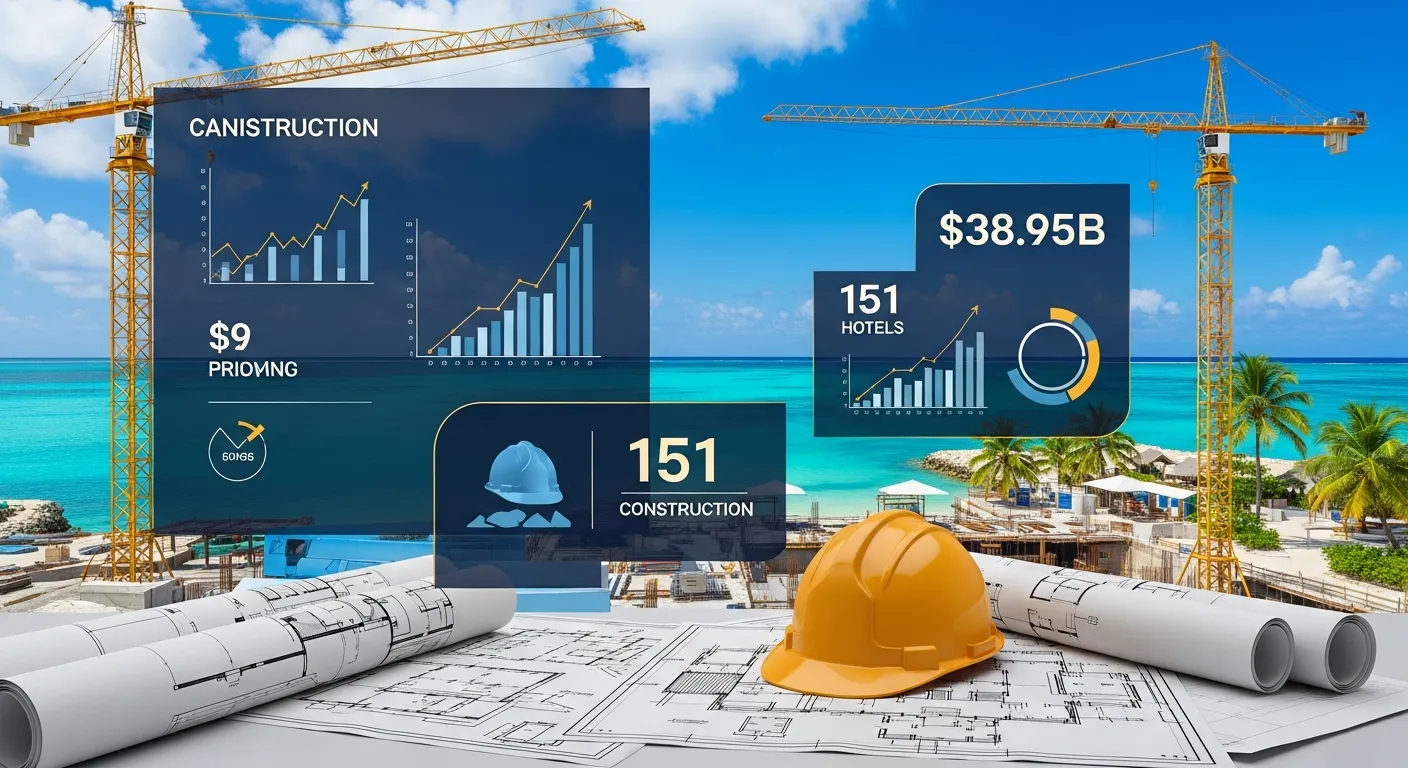
The Caribbean construction sector is running two parallel tracks simultaneously: an extraordinary luxury hospitality build-out with 151 hotels and 31,300 rooms actively under development across the region as of 2024, and a sweeping infrastructure and residential expansion anchored by the Dominican Republic's US$38.95 billion construction market growing at a 6.7% CAGR (Lodging Econometrics via Hospitality Design, 2024; Mordor Intelligence, 2025). For developers, contractors, investors, and suppliers, few regions in the Americas offer the combination of market scale, brand presence, and structural demand drivers that currently characterize Caribbean construction.
Caribbean Construction Market: Key Statistics 2024 to 2025
151
Hotels in active Caribbean pipeline totaling 31,300 rooms (Lodging Econometrics, 2024)
$38.95B
Dominican Republic construction market in 2025 (Mordor Intelligence, 2025)
6.7%
DR CAGR 2025 to 2030 projecting to $53.87B (Mordor Intelligence, 2025)
29,987
Rooms in Caribbean planning pipeline 2024 to 2028 (CHTA, 2024)
$700M+
Baha Mar expansion groundbreaking, Nassau, Bahamas (Baha Mar, 2025)
19%
Average Caribbean construction cost surge across the region (BCQS, 2023)
Executive Summary: Tourism Capital Drives a Construction Supercycle
Caribbean construction activity is being driven by the convergence of four structural forces: record-setting hotel RevPAR performance that has sustained investor confidence since 2022, diaspora-funded residential demand building momentum in markets like Jamaica and the Dominican Republic, public infrastructure investment scaling up under government development plans, and free-trade zone expansion creating industrial construction demand at a pace not seen in decades. The result is a region-wide construction pipeline that remains among the most active in the Americas despite rising costs and a tightening financing environment.
The Caribbean Hotel and Tourism Association's benchmarking report documents 50 activated hotel projects adding 19,591 rooms, with 29,987 total rooms across all stages of planning for the 2024 to 2028 period (CHTA, 2024). The hospitality segment is now dominated by luxury and upper-upscale development, with branded residences becoming the dominant financing model for new builds. In this structure, units are sold to private owners who use the resort's amenities, providing developers with presale revenue that can service construction debt before a single guest room is opened.
Caribbean Construction Activity by Sector
Loading chart...
Caribbean Hotel Development Pipeline: Key Projects and Markets 2024 to 2029
Hotel Pipeline by Country, 2024
Loading chart...
Baha Mar Expansion
BahamasOver $700M; 345 rooms and 77 branded residences; Foster + Partners design
Opening
2029
Baha Mar / EWN, 2025
Four Seasons Tropicalia
Dominican Republic95-key resort and 25 branded residences on Playa Esmeralda beachfront
Opening
2026
Hospitality Design, 2024
Vie L'Ven Luxury Resort
St. Maarten280 units comprising hotel rooms, suites, and residences at Indigo Bay
Opening
2028
TEMPO Networks, 2024
Grand Hyatt Grand Cayman
Cayman Islands351 rooms, studio suites, and residences representing Hyatt's Cayman debut
Opening
2026
TEMPO Networks, 2024
Unico Hotel 1877 Jamaica
Jamaica450-room luxury resort in Montego Bay
Opening
2025
TEMPO Networks, 2024
DR Hotel Pipeline Overall
Dominican Republic48 active projects; tourism construction forecast to pass $10B by 2030
Opening
Ongoing
Hospitality Design; Mordor, 2025
Free Caribbean Market Assessment
Discover which research methodology best fits your Caribbean market entry strategy.
Dominican Republic: The Caribbean's Construction Engine
No Caribbean market is driving more construction activity in absolute terms than the Dominican Republic. The market reached an estimated US$38.95 billion in 2025 and is forecast to grow at a 6.7% CAGR to US$53.87 billion by 2030, with the commercial segment leading at an 8.40% CAGR fueled by sustained tourism pipelines and free-trade zone expansion (Mordor Intelligence, 2025). Residential construction accounts for 34.07% of market share, anchored by remittance-funded self-builds and government social housing programs concentrated in Santo Domingo and Santiago (Mordor Intelligence, 2025).
Dominican Republic Construction Market Forecast
Loading chart...
The macroeconomic conditions underpinning this growth are exceptional by Caribbean standards. The Dominican Republic achieved approximately 5% real GDP growth in 2024 according to the IMF, while interest rates declined from 7.0% in August 2024 to 5.75% by December 2024. The World Bank estimates that this rate reduction stimulated private credit growth of 10.6% that has been channeled into industrial, housing, and transport infrastructure projects (GlobalData, 2025). The Association of Industries of the Dominican Republic announced plans to invest DOP87 billion, equivalent to approximately US$1.4 billion, in industrial development in 2025, targeting logistics, semiconductors, and energy alongside traditional tourism and construction (GlobalData, 2025).
The Dominican Republic's 87 free-trade zone parks represent one of the region's most significant industrial construction demand drivers. Medical device manufacturers are leading a pipeline of clean-room factory construction that requires strict HVAC, utility, and environmental standards considerably above typical regional project specifications. Eaton's US$150 million fuse-assembly plant in Santiago has been cited as a high-spec industrial reference for local builders (Mordor Intelligence, 2025). Greater Santo Domingo alone absorbs 38% of nationwide construction spending and is projected to advance at a 6.2% CAGR through 2030 (Mordor Intelligence, 2025).
Dominican Republic Construction: Key Investment Signals
- $38.95B market in 2025 growing to $53.87B by 2030 at a 6.7% CAGR (Mordor Intelligence, 2025)
- 48 hotel projects under active development, representing the largest pipeline in the Caribbean (Hospitality Design, 2024)
- $1.4B AIRD industrial investment planned for 2025 targeting logistics, semiconductors, and energy (GlobalData, 2025)
- Tourism construction alone is forecast to exceed $10B by 2030 (Mordor Intelligence, 2025)
- PPP Law 47-20 has opened long-term capital access and attracted global contractors to highway, airport, and renewable energy tenders (Mordor Intelligence, 2025)
- 56.78% private-funded in 2024, with public spending growing at an 8.90% CAGR through 2030 (Mordor Intelligence, 2025)
Caribbean Construction Cost Benchmarks: Per-Market Analysis
The Caribbean is structurally among the most expensive construction environments in the Western Hemisphere owing to island logistics, import-heavy supply chains, import duties ranging from 0% in St. Maarten to 100% on luxury goods in Barbados and Guyana, and insurance premiums that surged 40 to 50% for catastrophe-exposed properties with poor risk quality (BCQS via Hotel Investment Today, 2023). Average costs surged approximately 19% across the region over the survey period, with the Bahamas, Jamaica, St. Maarten, and Guyana all recording increases of 20 to 22%, while Curaçao remained at the lower end at 13.1% (BCQS, 2023).
5-Star Hotel Construction Cost Benchmarks (USD/sq ft)
Loading chart...
St. Barthélemy
$630-$1,350/sq ft
Highest cost market; ultra-luxury specification drives premium pricing
Bahamas
$460-$800/sq ft
20-22% cost increase; anchor resort projects like Baha Mar at top of range
Trinidad & Tobago
$250-$410/sq ft
Most cost-competitive major market; local materials supply advantage
Source: BCQS Caribbean Construction and Development Cost Benchmarking, cited in Hotel Investment Today (2023). Costs are indicative for typical 5-star, low-rise properties. Luxury costs vary significantly based on site conditions, specification level, and the import duty structures specific to each jurisdiction.
Residential and Infrastructure: The Other Construction Drivers
While tourism hospitality dominates Caribbean construction headlines, residential and infrastructure segments represent a substantial and underreported share of regional activity. In Jamaica, diaspora investment is actively reshaping the residential market, with new construction in St. James, Trelawny, and the Corporate Area targeting diaspora buyers who bring expectations for modern layouts, solar infrastructure, and enhanced security that are elevating build standards across the sector. The Jamaica Social Investment Fund executed projects valued at over JMD3 billion in a single year, funded by the Government of Jamaica, the World Bank, the European Union, and the Caribbean Development Bank (JIS, 2024).
Caribbean hardware and building materials, a useful proxy for residential and small commercial construction activity, represent a growing market segment. Construction sands consumption in Latin America and the Caribbean grew 16% in 2024, with the Dominican Republic recording the highest import growth rate over the review period, signaling the volume of residential and commercial ground-up development underway (IndexBox, 2025).
Infrastructure investment is scaling up across multiple markets simultaneously. The Dominican Republic's Metro Line 2C extension worth US$250 million, urban cable car project worth US$250 million, and the CABEI PLANACOVIAL highway loan of US$421 million represent the largest individual public construction commitments in the region (Mordor Intelligence, 2025). In Barbados and Eastern Caribbean OECS markets, port modernization, road rehabilitation, and climate resilience infrastructure are the dominant public spending categories, increasingly co-financed by the Inter-American Development Bank and the Caribbean Development Bank.
Financing, Insurance, and the Development Risk Environment
Despite strong pipeline confidence, the Caribbean construction sector faces a tightening financing environment. Hotel occupancy remained in the mid-70s with ADR at historical highs in 2024 and 2025, validating the underlying economics of the hospitality investment thesis (CHICOS, 2025). However, as the 2025 CHICOS conference highlighted, developers must be more creative with their capital stack, with higher insurance costs representing one of the most significant challenge variables for both new developments and existing assets (CHICOS, 2025).
Insurance premiums for catastrophe-exposed properties surged as much as 40 to 50% for poor-risk-quality properties across the Caribbean, a cost that directly affects project feasibility calculations and debt coverage ratios (BCQS via Hotel Investment Today, 2023). Baha Mar's groundbreaking in early 2025 on a project exceeding US$700M, supported by the Bahamian government's Heads of Agreement, illustrates how anchor resort investments at this scale require sovereign-level partnership structures to de-risk capital effectively (Baha Mar, 2025).
HRG Research Capabilities in Caribbean Construction and Real Estate
Hope Research Group supports real estate developers, construction firms, materials suppliers, and institutional investors operating across Caribbean construction markets. Our research capabilities include market sizing and feasibility assessment, competitive landscape mapping, consumer preference studies for residential and mixed-use projects, and workforce and skills gap research across key construction markets.
For developers planning hotel or residential projects in the Dominican Republic, Jamaica, the Bahamas, or Eastern Caribbean OECS markets, HRG provides primary research that quantifies buyer intent, pricing tolerance, and amenity preferences across relevant consumer segments including diaspora buyers, local middle-income households, and luxury international travelers. Our tourism and hospitality research practice covers the full pipeline from site feasibility through to pre-opening brand positioning.
Frequently Asked Questions
How large is the Caribbean hotel and resort construction pipeline?
The Caribbean hotel pipeline stands at 151 hotels totaling 31,300 rooms actively under development as of 2024 (Lodging Econometrics via Hospitality Design, 2024). CHTA identified 50 activated hotel projects adding 19,591 rooms, with 29,987 total rooms across all planning stages for the 2024 to 2028 period (CHTA, 2024). The Dominican Republic leads with 48 active projects and represents the busiest development queue in the Caribbean.
What is the Dominican Republic construction market size?
The DR construction market reached approximately US$38.95 billion in 2025 and is projected to grow at a 6.7% CAGR to US$53.87 billion by 2030 (Mordor Intelligence, 2025). The industry grew 2.1% in real terms in 2024, forecast to accelerate to 3.9% in 2025 and 4.3% AAGR from 2026 to 2029 (GlobalData, 2025), driven by tourism, free-trade zone industrial development, and public infrastructure investment.
How much does it cost to build a hotel in the Caribbean?
Indicative per-square-foot costs for a 5-star, low-rise hotel range from US$250 to $410 in Trinidad and Tobago, US$460 to $800 in the Bahamas, and up to US$630 to $1,350 in St. Barthélemy (BCQS, 2023). Average Caribbean construction costs surged approximately 19% over the recent survey period, driven by inflation, import duties, and insurance premium increases of 40 to 50% for catastrophe-exposed properties (BCQS, 2023).
What are the biggest construction projects in the Caribbean?
The most significant active projects include Baha Mar's more than $700M expansion in Nassau with 345 rooms and 77 branded residences completing in 2029; Four Seasons Resort Tropicalia in the Dominican Republic opening in 2026; Vie L'Ven Luxury Resort in St. Maarten with 280 units in 2028; and Grand Hyatt Grand Cayman with 351 rooms. The Dominican Republic's tourism construction market alone is forecast to exceed $10 billion by 2030 (Mordor Intelligence, 2025).
Caribbean Market Intelligence
Monthly research insights, consumer trends data, and industry analysis from 30+ Caribbean and Latin American markets.
Need Caribbean Construction and Real Estate Market Intelligence?
Hope Research Group provides feasibility research, consumer preference studies, and competitive landscape assessments for developers, investors, and contractors operating across Caribbean construction markets. From the Dominican Republic to the OECS, we deliver the on-the-ground market intelligence that informs better investment decisions.
Speak to Our Construction Research TeamRelated Research
Caribbean Real Estate Market Trends
Property prices, CBI-driven demand, and residential market dynamics across key Caribbean markets
Caribbean Insurance Market Analysis
Property insurance penetration, CCRIF parametric coverage, and the construction sector's climate risk exposure
Caribbean Renewable Energy Market
Solar, wind, and energy storage infrastructure driving new construction procurement across the region
Caribbean Beauty & Personal Care Market
Covering consumer trends, brand landscape, and per-country data across six Caribbean markets
Eastern Caribbean Market Research
OECS market overview and investment landscape across St. Lucia, Antigua, Dominica, Grenada, and beyond
Caribbean Hotel Construction Cost Per Key 2025
Island-by-island cost benchmarks: DR, Jamaica, Bahamas, Barbados, Anguilla - $80K to $1.2M+ per key
Caribbean construction market trends Research Report
Get our comprehensive caribbean construction market trends data pack with market analysis, competitive insights, and growth forecasts for strategic planning.