Haiti Consumer Trends 2025: $32B GDP, 11.8M Population, $4.1B Remittances & Mobile Money Data
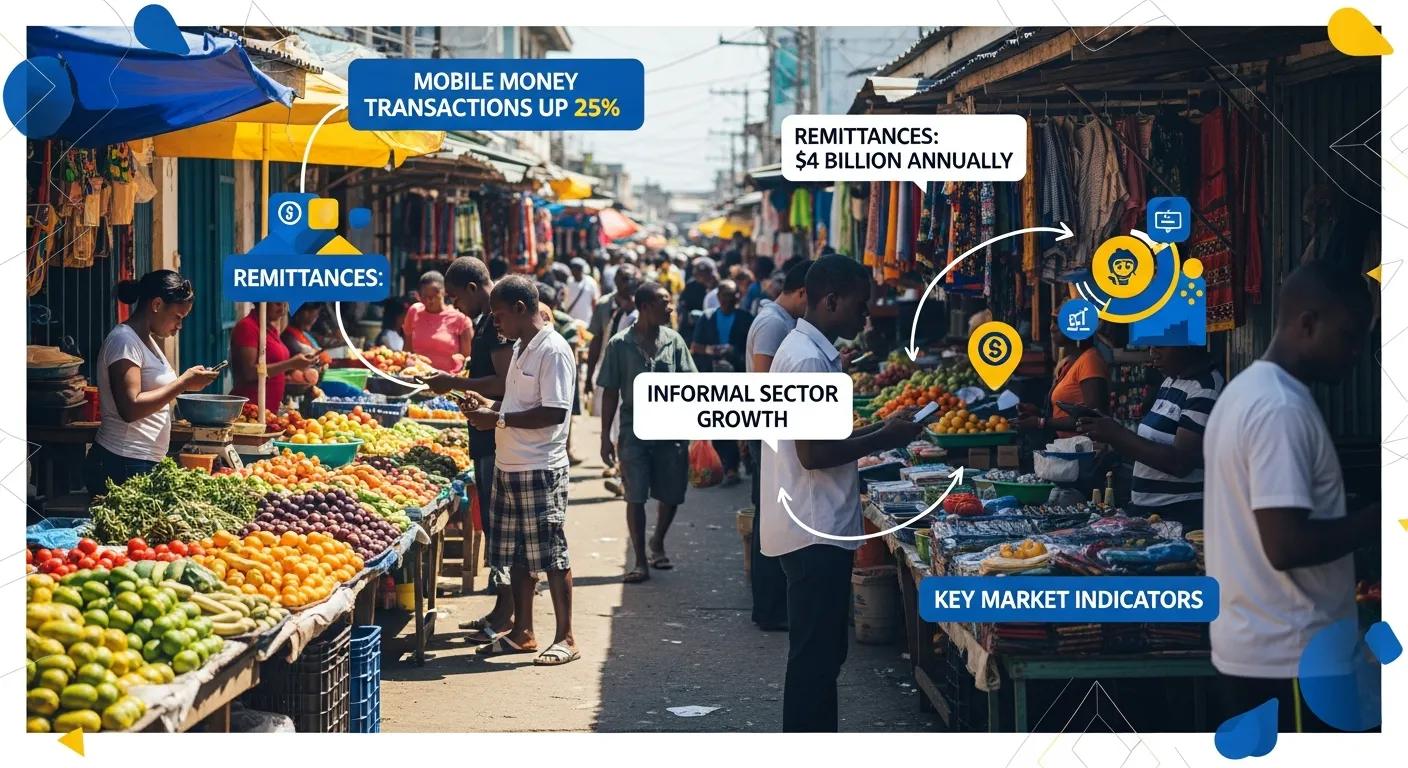
Haiti's 11.8 million consumers (World Bank, 2024) form the Caribbean's largest French Creole-speaking market and one of the region's most significant untapped consumer opportunities. With a $32.1B GDP (World Bank, 2025), $4.1B in annual remittances (World Bank, 2024) representing 17% of GDP, and 2 million MonCash mobile money users (Digicel, 2024), Haiti's consumer economy operates through channels fundamentally different from traditional Caribbean markets.
Haiti Consumer Market Key Statistics 2025
11.8M
Population (World Bank, 2024)
$32.1B
GDP (World Bank, 2025)
$2,694
GDP per capita (World Bank NY.GDP.PCAP.CD, 2025)
$4.1B
Annual remittances (World Bank, 2024)
17%
Remittances as % of GDP (World Bank BX.TRF.PWKR.DT.GD.ZS, 2024)
2M
MonCash mobile money users (Digicel, 2024)
Economic Overview & Market Context
Haiti's economy presents a paradox: the Caribbean's lowest nominal GDP per capita ($2,694, World Bank NY.GDP.PCAP.CD, 2025) coexists with a large population base of 11.8 million that generates substantial aggregate consumer demand. The informal economy accounts for approximately 49% of economic activity (ILO), making traditional market measurement challenging but also signaling massive unreported consumer spending. The median age of 24.1 years (UN Population Division) makes Haiti the youngest population in the Caribbean region, creating distinct consumer preferences and digital adoption patterns.
Haitian Creole is the universal spoken language, while French serves as the official administrative language used by a smaller educated segment. Any brand or marketing effort targeting Haitian consumers must operate in Creole for effective mass-market reach, with French reserved for institutional and premium positioning.
Remittances: The Consumer Economy's Lifeline
Remittances of $4.1B annually (World Bank, 2024) represent approximately 17% of GDP (World Bank BX.TRF.PWKR.DT.GD.ZS, 2024), four times larger than total exports. The Haitian diaspora, with over 1 million in the United States (US Census Bureau), 100,000+ in Canada, and significant communities in France, the Dominican Republic, and the Bahamas, directly sustains household consumer spending across the country.
Remittances & Consumer Spending Patterns
- $4.1B in remittances (2024): Representing 17% of GDP (World Bank BX.TRF.PWKR.DT.GD.ZS, 2024), 4x larger than exports (World Bank, 2024)
- Food spending dominance: 80.9% of remittances spent on food (IDB study), reflecting basic needs prioritization
- Transfer channels: Western Union, MoneyGram, CAM Transfer, and increasingly mobile money platforms
- Diaspora influence: 1M+ Haitians in the US (US Census Bureau) drive consumption patterns through remittances and product shipments
- Seasonal spikes: Remittance flows increase during holidays, back-to-school season, and after natural disasters
Free Caribbean Market Assessment
Discover which research methodology best fits your Caribbean market entry strategy.
Retail Channels & Shopping Behavior
Haiti's retail landscape is dominated by informal channels that serve the vast majority of consumer transactions. Open-air markets (marchés) are the primary shopping venues for food, household goods, and clothing. Port-au-Prince's Iron Market (Marché en Fer), rebuilt after the 2010 earthquake, is the most iconic commercial space. Formal retail is concentrated in Port-au-Prince's Pétion-Ville district, serving upper-income consumers.
| Channel | Key Players | Consumer Segment | Trend |
|---|---|---|---|
| Open-Air Markets (Marchés) | Iron Market, neighborhood marchés | Mass market, all income levels | Dominant |
| Supermarkets | Caribbean Supermarkets, Giant Supermarket | Upper-income, Pétion-Ville | Growing |
| Street Vendors (Ti Machann) | Independent micro-entrepreneurs | Low-income, convenience | Stable |
| Mobile Money Agents | MonCash (Digicel), 4,000+ agents | Financial services, bill payment | Fast Growing |
| Boutiques/Small Shops | Independent operators | Neighborhood retail, daily needs | Stable |
MonCash & Mobile Money Revolution
MonCash, operated by Digicel Haiti, has become the dominant mobile money platform with 2 million users and over 4,000 agents nationwide (Digicel, 2024). In a market where traditional banking reaches less than 20% of the population, mobile money represents a financial inclusion leapfrog. MonCash enables peer-to-peer transfers, bill payments, merchant transactions, and increasingly serves as a remittance receiving channel-competing directly with traditional money transfer operators.
Mobile Money & Financial Access
2M
MonCash users (Digicel, 2024)
4,000+
MonCash agent locations nationwide
<20%
Traditional bank account penetration
49%
Informal economy share (ILO)
Consumer Brand Preferences
Food & Grocery
Haitian consumer spending is heavily concentrated on food, with 80.9% of remittances directed toward food purchases (IDB study). Rice, beans, cooking oil, and chicken are staple products. Imported rice (primarily from the US) accounts for a significant share of food imports. Local brands compete with imported products, but brand loyalty is generally weaker than in wealthier Caribbean markets-price sensitivity dominates purchase decisions for the majority of consumers.
Telecommunications
Digicel Haiti is the dominant telecommunications provider, with mobile services reaching a larger share of the population than any other utility or service. Natcom (Vietnamese-backed) competes as the second carrier. Mobile phone ownership exceeds formal banking access, making mobile-first strategies essential for reaching Haitian consumers. Affordable data plans and WhatsApp usage are driving social media engagement and emerging social commerce.
Beverages
Prestige Beer, brewed by Brasserie Nationale d'Haïti, is the iconic national beer brand with deep cultural resonance. Barbancourt Rum is Haiti's most recognized export brand, with premium positioning both domestically and internationally. The local beverage market shows strong loyalty to national brands, representing an area of consumer pride and identity even amid economic challenges.
Youth Demographics & Future Market
With a median age of 24.1 years (UN Population Division), Haiti has the youngest population in the Caribbean region. This youthful demographic creates distinct consumer patterns: higher mobile phone engagement, greater openness to new products and brands, and emerging digital consumption habits. While current purchasing power is limited, this demographic represents the future consumer base and merits long-term brand-building investment.
Key Consumer Trends for 2025
1. Mobile Money Expansion
MonCash's growth trajectory suggests mobile money will become the default financial channel for Haitian consumers. Agent banking networks are expanding into secondary cities and rural areas, bringing formal financial services to previously unbanked populations. This creates opportunities for mobile-enabled commerce, bill payment services, and digital savings products tailored to low-income consumers.
2. Remittance-Driven Consumption
As remittance channels digitize and transfer costs decrease, the effective purchasing power of diaspora-funded consumption increases. Competition among remittance providers (Western Union, MoneyGram, CAM Transfer, mobile platforms) benefits consumers through lower fees. Brands that integrate with remittance flows-particularly in food retail and household goods-access a reliable, externally funded demand stream.
3. Informal-to-Formal Retail Transition
While open-air markets remain dominant, gradual formalization of retail is occurring in Port-au-Prince and Cap-Haïtien. New supermarket and convenience store formats are emerging in Pétion-Ville and other affluent neighborhoods. This transition creates distribution channel opportunities for packaged goods brands seeking to move from informal market penetration to formal retail presence.
4. Consumer Resilience Innovation
Haitian consumers demonstrate extraordinary resilience, adapting spending patterns to economic volatility, natural disasters, and supply chain disruptions. This resilience drives demand for affordable, durable, and multi-purpose products. Brands that offer genuine value-not merely low prices-earn loyalty in a market where every purchase decision is carefully considered.
Haiti Market Entry Considerations
- Language: Haitian Creole is essential for mass-market reach; French for institutional/premium positioning
- Distribution: Open-air markets and street vendors are primary channels; formal retail concentrated in Pétion-Ville
- Payment: Mobile money (MonCash) and cash dominate; traditional banking reaches <20% of population
- Pricing: Extreme price sensitivity; sachet/single-serve formats essential for mass-market products
- Remittance link: 80.9% of remittances spent on food (IDB study); align with remittance-funded purchases
- Youth market: Median age 24.1 (UN Population Division), youngest Caribbean population, mobile-first
Frequently Asked Questions
What is the size of the Haiti consumer market?
Haiti has a $32.1B GDP (World Bank, 2025) with 11.8M consumers, the largest French Creole-speaking market in the Caribbean. GDP per capita is $2,694 (World Bank NY.GDP.PCAP.CD, 2025). Remittances of $4.1B (World Bank, 2024) represent 17% of GDP and are the primary driver of household consumer spending.
How do remittances drive Haitian consumer spending?
Haiti received $4.1B in remittances in 2024 (World Bank), representing 17% of GDP, 4x larger than exports. An IDB study found 80.9% of remittances are spent on food. The diaspora (1M+ in the US, per US Census Bureau) directly sustains household consumption across the country.
What is MonCash and how important is mobile money in Haiti?
MonCash (Digicel Haiti) is the dominant mobile money platform with 2M users and 4,000+ agents (Digicel, 2024). With traditional banking reaching <20% of the population, mobile money has become the primary financial channel for payments, transfers, and bill settlements.
What are the main retail channels in Haiti?
Open-air markets (marchés) dominate retail, with the Iron Market in Port-au-Prince as the most iconic. Caribbean Supermarkets and Giant Supermarket serve formal retail in Pétion-Ville. The informal economy accounts for 49% of activity (ILO). MonCash agents serve as supplementary financial access points.
Caribbean Market Intelligence
Monthly research insights, consumer trends data, and industry analysis from 30+ Caribbean and Latin American markets.
Need Haiti Consumer Insights?
Our Caribbean research team provides deep Haitian market understanding backed by regional research expertise since 1985. Get custom consumer data, mobile money market analysis, and market entry support for Haiti's 11.8M-consumer market.
Contact Our Caribbean TeamRelated Research
Market Research in Haiti
Comprehensive overview of Haiti market research capabilities
Caribbean Mobile Money Adoption
Mobile money and fintech trends across the Caribbean
Caribbean Diaspora Consumer Research
How diaspora spending and remittances shape Caribbean markets
Caribbean Consumer Behavior Trends
Multi-market consumer tracking insights across Caribbean islands and diaspora communities
haiti consumer trends Research Report
Get our comprehensive haiti consumer trends data pack with market analysis, competitive insights, and growth forecasts for strategic planning.