Caribbean Cruise Passenger Spending 2024: $104.36 Avg Per Port Visit, FCCA/BREA Data by Destination
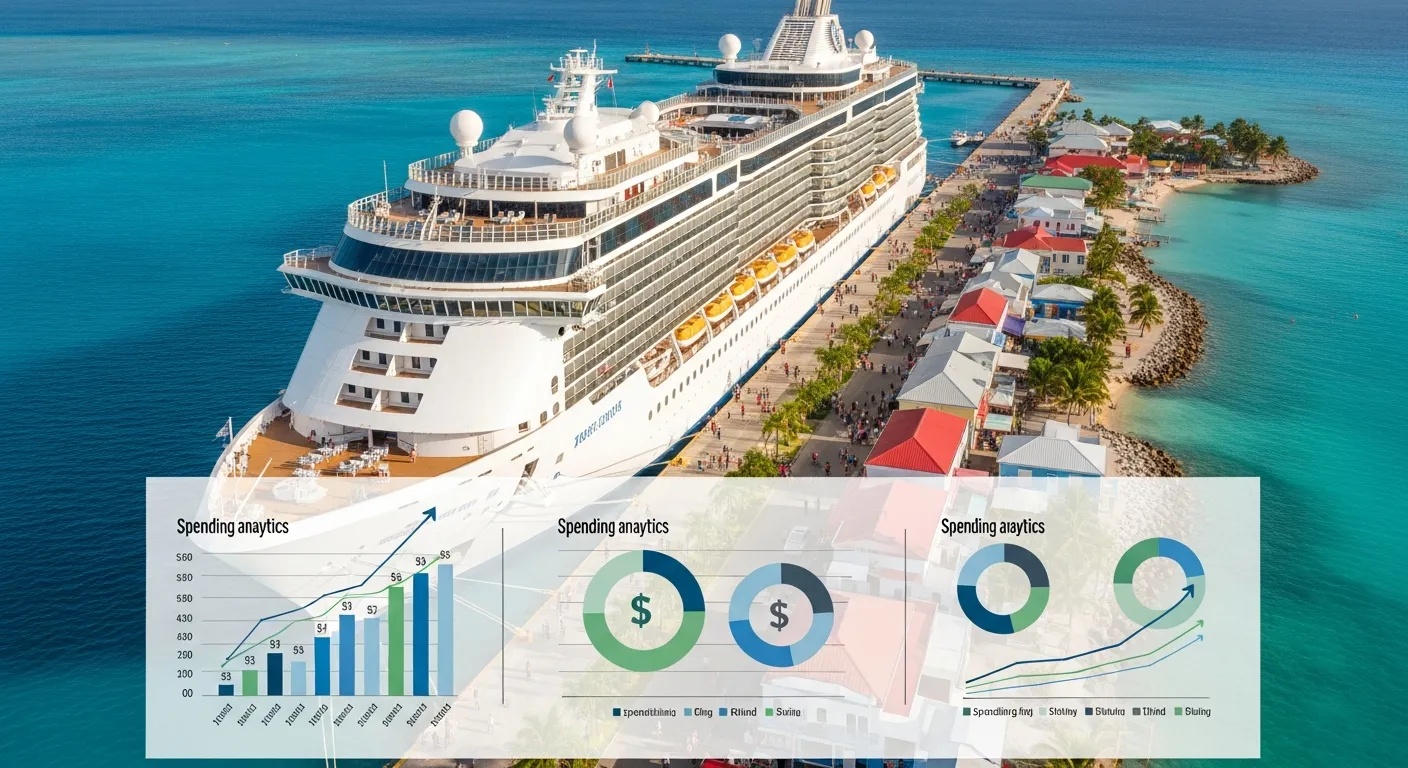
Caribbean cruise tourism generated $4.27 billion in direct expenditures during the 2023-2024 study period, a 27% increase over the previous FCCA/BREA benchmark study conducted in 2018 (FCCA/BREA Economic Impact Study, 2024). With 33.3 million total passenger and crew visits across 33 destinations — as detailed in our Caribbean Cruise Industry Analysis — the average cruise passenger now spends $104.36 per onshore port visit, a 2.8% increase from $101.52 in 2018. This analysis breaks down spending patterns by port, expenditure category, and emerging trends reshaping how cruise tourism dollars flow through Caribbean economies.
Caribbean Cruise Spending: Key Statistics 2024
$4.27B
Total direct cruise expenditures, 27% increase vs 2018 (FCCA/BREA, 2024)
$104.36
Average passenger spend per port visit (FCCA/BREA, 2024)
33.3M
Total passenger & crew visits across 33 destinations (FCCA/BREA, 2024)
94,027
Jobs supported by cruise tourism, 19% increase vs 2018 (FCCA/BREA, 2024)
$3.07B
Passenger direct spending from 29.4M onshore visits (FCCA/BREA, 2024)
$1.27B
Total wage income generated regionally (FCCA/BREA, 2024)
Per-Passenger Spending by Destination
Per-passenger spending varies significantly across Caribbean destinations, driven by differences in duty-free shopping availability, excursion infrastructure, port walkability, and retail concentration. The U.S. Virgin Islands leads all destinations at $176.73 per passenger visit, reflecting its strong duty-free positioning and established jewelry retail corridor in Charlotte Amalie (FCCA/BREA, 2024). The Bahamas ranks second at $149.12, boosted by Nassau's $350 million cruise port redevelopment completed in 2023 that added retail and entertainment zones (Global Ports Holding, 2024).
Notably, 14 destinations now exceed $100 in average passenger spend, up from 12 in the 2018 study, and 26 of 31 comparable destinations saw increased per-passenger spending (FCCA/BREA, 2024). This broad-based growth reflects both inflationary effects and improved port-side retail and excursion offerings across the region.
| Rank | Destination | Avg. Passenger Spend | Total Expenditure | Source |
|---|---|---|---|---|
| 1 | U.S. Virgin Islands | $176.73 | $258.1M | FCCA/BREA, 2024 |
| 2 | Bahamas | $149.12 | $654.8M | FCCA/BREA, 2024 |
| 3 | St. Maarten | $134.29 | $237.8M | FCCA/BREA, 2024 |
| 4 | Aruba | $131.15 | $118.4M | FCCA/BREA, 2024 |
| 5 | Puerto Rico | $126.40 | $202.0M | FCCA/BREA, 2024 |
| 6 | Cozumel, Mexico | $118.65 | $483.1M | FCCA/BREA, 2024 |
| 7 | Cayman Islands | $112.58 | $161.5M | FCCA/BREA, 2024 |
| 8 | Jamaica | $107.82 | $198.0M | FCCA/BREA, 2024 |
| 9 | Honduras | $89.47 | $180.0M | FCCA/BREA, 2024 |
| 10 | Belize | $73.21 | $85.6M | FCCA/BREA, 2024 |
Source: FCCA/BREA Economic Impact of Cruise Tourism, Vol. I & II, October 2024. Average passenger spending figures are derived from passenger surveys conducted across 33 Caribbean and Latin American destinations, May 2023 - April 2024.
Average Passenger Spending by Port
Loading chart...
Spending Category Breakdown: Excursions Lead, Jewelry Declines
Shore excursions remain the dominant spending category, accounting for approximately 32% of total passenger onshore expenditure (FCCA/BREA, 2024). This reflects a broader industry trend toward experiential spending, with cruise lines and independent operators expanding excursion offerings to include cultural immersion, adventure activities, and culinary experiences. A typical transit cruise call carrying 4,000 passengers and 1,640 crew generates approximately $369,100 in total spending, $339,800 from passengers and $29,300 from crew (FCCA/BREA, 2024).
The most notable shift in the 2024 study is the significant decline in jewelry and watch spending, which decreased by $8.52 per passenger, a 26% drop compared to 2018 (FCCA/BREA, 2024). This decline is attributed to changing consumer preferences among younger cruise demographics, increased competition from online retailers, and reduced duty-free appeal as jewelry purchasing moves to digital channels. Despite this decline, jewelry remains the second-largest spending category at 19% of total expenditure, reflecting the enduring strength of Caribbean duty-free jewelry retail corridors in destinations like St. Thomas, St. Maarten, and Nassau.
Passenger Spending Category Breakdown
Loading chart...
| Spending Category | % of Total | Avg. Per Passenger | Trend vs. 2018 |
|---|---|---|---|
| Shore Excursions | 32% | $33.40 | ↑ Growing |
| Jewelry & Watches | 19% | $19.83 | ↓ -26% ($8.52 decline) |
| Food & Beverages | 18% | $18.78 | ↑ Growing |
| Clothing & Souvenirs | 15% | $15.65 | ↑ Growing |
| Local Transportation | 9% | $9.39 | → Stable |
| Other Retail | 7% | $7.31 | → Stable |
Source: FCCA/BREA Economic Impact Study, Vol. I, October 2024. Category percentages based on passenger survey data across 33 destinations.
Free Caribbean Market Assessment
Discover which research methodology best fits your Caribbean market entry strategy.
Spending Trends Over Time: Steady Growth Despite Disruptions
Average passenger spending has shown consistent upward trajectory over successive FCCA/BREA study periods, rising from $74.89 in the 2012 study to $104.36 in the 2024 study, a cumulative 39.3% increase over the 12-year period (FCCA/BREA studies, 2012-2024). Crew spending has remained relatively flat at approximately $58-$60 per visit, with a slight 2.7% decline between 2018 and 2024 attributed to lower crew disembarkation rates, which decreased by 9 percentage points over the same period (FCCA/BREA, 2024).
The 2023-2024 study period captured spending during a record-setting period for Caribbean cruise deployments, with total passenger visits increasing 13% compared to the 2018 baseline and 17% across 31 common destinations (FCCA/BREA, 2024). This volume growth, combined with modest per-person spending increases, drove the aggregate $4.27 billion in expenditures, the highest ever recorded in the study's history dating back to 2001.
Passenger & Crew Spending Trends Over Time
Loading chart...
Top Destinations by Total Expenditure
While per-passenger spending rates are useful for benchmarking destination competitiveness, total expenditure reflects the combined effect of spending rates and passenger volume. The Bahamas leads all destinations with $654.8 million in total cruise-related expenditure, driven by the highest visitor volumes in the region and the $350 million Nassau Cruise Port redevelopment that significantly enhanced the passenger experience (FCCA/BREA, 2024; Global Ports Holding, 2024). Cozumel ranks second at $483.1 million, leveraging its position as the Caribbean's busiest single port by ship calls with proximity to major Gulf Coast and Florida homeports.
The top five destinations, Bahamas, Cozumel, USVI, Dominican Republic, and St. Maarten, collectively accounted for 44% of total regional cruise expenditures (FCCA/BREA, 2024). This concentration highlights both the outsized economic importance of cruise tourism to these destinations and the competitive challenge facing smaller ports in capturing a meaningful share of cruise spending.
Cruise Line Direct Spending & Economic Multiplier Effects
Beyond passenger and crew spending, cruise lines directly contribute $968.3 million annually to Caribbean economies through provisioning, port services, local employment, and port fees, an average of $29.3 million per destination (FCCA/BREA, 2024). This spending is critical for port communities as it represents recurring commercial transactions that are less discretionary than passenger spending and provide stable revenue streams for local businesses.
The economic multiplier effect of cruise tourism extends well beyond direct expenditures. When cruise passengers purchase shore excursions, the excursion operator spends on fuel, equipment, guides, insurance, and vehicle maintenance, each layer creating additional income and employment. The BREA methodology captures only direct impacts; the total economic contribution including indirect and induced effects is estimated to be 1.5x to 2.0x the direct spending figure, suggesting a total Caribbean cruise economic footprint of approximately $6.4 billion to $8.5 billion annually (BREA methodology notes, 2024).
Cruise Line Direct Spending Breakdown
- $968.3M total cruise line spending across 33 destinations (FCCA/BREA, 2024)
- $29.3M average per destination in cruise line direct expenditure
- Provisions & supplies: Food, fuel, and ship supplies sourced from local vendors
- Port fees & pilotage: Docking charges, piloting, and harbor services
- Local employment: Shore-side operations, stevedoring, and logistics
- 1.5x-2.0x multiplier: Estimated total impact including indirect and induced effects (BREA, 2024)
Crew Spending: A Declining but Significant Revenue Stream
Cruise crew spending contributes $229.5 million annually from 3.9 million onshore visits, with the average crew member spending $58.78 per port visit (FCCA/BREA, 2024). While crew represent a smaller spending segment than passengers, their spending is concentrated in different categories, primarily food and beverages, telecommunications, and personal care products, and benefits different local businesses than passenger-oriented retail.
The 2024 study noted a concerning trend: crew disembarkation rates decreased by 9 percentage points compared to 2018, and per-person crew spending declined 2.7% from $60.44 to $58.78 (FCCA/BREA, 2024). This may reflect operational changes including shorter port times, enhanced onboard amenities reducing crew incentive to go ashore, and post-pandemic scheduling adjustments. In the USVI, for example, 170,000 crew visits generated approximately $10 million in spending, with crew expenditure representing about 4% of total cruise economic impact at that destination (FCCA/BREA, 2024).
Caribbean Market Intelligence
Monthly research insights, consumer trends data, and industry analysis from 30+ Caribbean and Latin American markets.
Employment Impact: 94,027 Jobs Supported
Caribbean cruise tourism supports 94,027 jobs across the 33 study destinations, a 19% increase from the previous study period (FCCA/BREA, 2024). These jobs generate $1.27 billion in total wage income, spanning roles in retail, excursion operations, ground transportation, food service, port operations, and administrative support. Employment impact varies significantly by destination, the USVI, for example, supports 5,095 cruise-related jobs (2,721 directly employed and 2,374 indirectly employed), representing a significant portion of the territory's total employment base (FCCA/BREA, 2024).
Implications for Caribbean Port Destinations
The data from the FCCA/BREA 2024 study highlights several strategic implications for Caribbean destinations seeking to maximize cruise tourism economic returns. First, the shift from product-based spending (jewelry) to experience-based spending (excursions) requires destinations to invest in unique, culturally authentic excursion products rather than relying solely on duty-free retail corridors. Second, port infrastructure improvements, as demonstrated by Nassau's $350 million redevelopment, directly correlate with increased passenger spending and volume growth. Third, the declining crew spending trend suggests destinations should develop targeted crew-friendly offerings to recapture this revenue stream.
For tourism boards, port authorities, and businesses operating in cruise-dependent Caribbean economies, these findings underscore the importance of data-driven tourism planning that looks beyond aggregate visitor numbers to understand the composition and trajectory of cruise-related expenditure. Hope Research Group tracks cruise tourism spending patterns and economic impact across 30+ Caribbean and Latin American markets, providing primary research that quantifies the opportunity landscape for businesses and policymakers.
Frequently Asked Questions
How much do cruise passengers spend on average per Caribbean port visit?
According to the FCCA/BREA 2024 study, cruise passengers spend an average of $104.36 per onshore port visit across 33 Caribbean and Latin American destinations, a 2.8% increase from $101.52 in 2018. Total passenger spending reached $3.07 billion from 29.4 million onshore visits.
Which Caribbean port has the highest per-passenger spending?
The U.S. Virgin Islands leads at $176.73 per passenger visit, followed by the Bahamas at $149.12, St. Maarten at $134.29, Aruba at $131.15, and Puerto Rico at $126.40 (FCCA/BREA, 2024).
What do cruise passengers spend the most money on?
Shore excursions account for 32% of total onshore spending. Jewelry & watches represent 19% (though this declined 26% vs 2018), food & beverages 18%, clothing & souvenirs 15%, local transport 9%, and other retail 7% (FCCA/BREA, 2024).
What is the total economic impact of cruise tourism in the Caribbean?
$4.27 billion in direct expenditures across 33 destinations (27% increase vs 2018), supporting 94,027 jobs and generating $1.27 billion in wage income. Including multiplier effects, the total economic footprint is estimated at $6.4B-$8.5B annually (FCCA/BREA, 2024).
How much do cruise ship crew members spend at Caribbean ports?
Crew members spend $58.78 on average per onshore visit, generating $229.5 million from 3.9 million visits. This represents a slight decline from $60.44 in 2018, with crew disembarkation rates also dropping 9 percentage points (FCCA/BREA, 2024).
Related Research
Caribbean Cruise Industry Analysis 2025
Market share, port rankings & capacity data
Caribbean Cruise Port Economics
Infrastructure investment, port fees & employment
Caribbean Tourism Statistics 2025
Visitor arrivals, spending & forecasts
Caribbean Carnival Economic Impact
$500M+ festival revenue analysis
Data Sources & Methodology
This analysis draws primarily on the FCCA/BREA Economic Impact of Cruise Tourism study (Volumes I & II), released October 2024 at the FCCA's 30th Annual Cruise Conference & Trade Show in St. Maarten. The study covers the 12-month period from May 2023 through April 2024 across 33 Caribbean and Latin American destinations.
- FCCA/BREA Economic Impact of Cruise Tourism, Vol. I & II (October 2024)
- Global Ports Holding, Nassau Cruise Port development data (2024)
- Caribbean Tourism Organization (CTO), Regional tourism statistics
- Individual port authority annual reports
- CLIA 2025 State of the Cruise Industry Report
Caribbean cruise passenger spending Research Report
Get our comprehensive caribbean cruise passenger spending data pack with market analysis, competitive insights, and growth forecasts for strategic planning.