Caribbean Cruise Port Economics 2025: $1.1B+ Investment
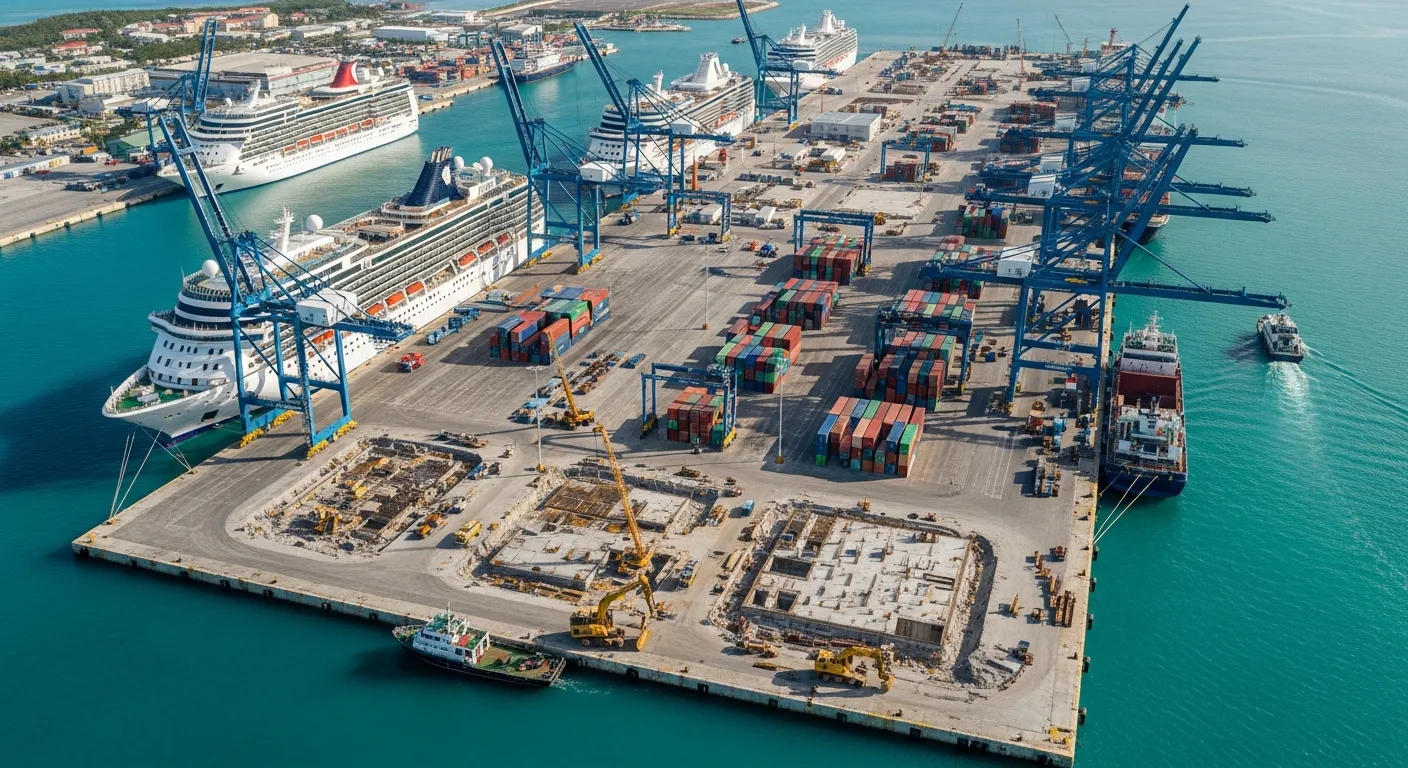
Caribbean cruise port infrastructure is undergoing a $1.1 billion+ investment cycle driven by the need to accommodate larger vessels, enhance passenger experiences, and capture a greater share of the $4.27 billion in annual cruise expenditures flowing through the region (FCCA/BREA, 2024). From Nassau's $350 million redevelopment that produced a 59% revenue surge to Grand Cayman's contentious $240 million berthing facility referendum, port economics are reshaping how Caribbean destinations compete for cruise tourism dollars. This analysis examines port infrastructure investment, revenue structures, capacity utilization, employment generation, and the environmental cost considerations shaping the next decade of Caribbean cruise port development.
Caribbean Cruise Port Economics: Key Statistics 2025
$1.1B+
Active & planned port infrastructure investment (Port authorities, CDB, 2024-2025)
$78M
Nassau Cruise Port projected 2025 revenue, +59% YoY (Global Ports Holding, 2025)
94,027
Jobs supported by cruise tourism across 33 destinations (FCCA/BREA, 2024)
33.3M
Total passenger & crew visits regionally (FCCA/BREA, 2024)
$968.3M
Cruise line direct spending on ports & services (FCCA/BREA, 2024)
30,598
Nassau daily passenger record, March 2025 (Nassau Cruise Port, 2025)
Port Infrastructure Investment: $1.1B+ Across 7 Major Projects
The Caribbean cruise port infrastructure pipeline exceeds $1.1 billion in active and planned projects, driven by the imperative to accommodate Oasis-class and Icon-class mega-ships carrying 5,000 to 7,000+ passengers. As covered in our Caribbean Cruise Industry Analysis, ports that cannot berth these vessels face declining ship calls and passenger volumes, as major cruise lines increasingly concentrate deployments at ports with modern facilities. The investment cycle is creating a two-tier port system: upgraded ports attracting premium mega-ship calls, and legacy ports competing for smaller vessel itineraries with lower economic returns. Port infrastructure developments also have significant implications for the broader Caribbean logistics market, as cruise and cargo operations often share facilities.
| Destination | Project | Investment | Status | Source |
|---|---|---|---|---|
| Nassau, Bahamas | Cruise port redevelopment: 6 berths, terminal, retail zones | $350M | Completed 2023 | Global Ports Holding, 2024 |
| Grand Cayman | Cruise berthing facility: 2 piers, 4 berths, terminal | $240M | Referendum Apr 2025 | Cayman Port Authority, 2025 |
| Barbados | Bridgetown Port expansion: new terminal, pier extension | $180M | Planning/Construction | Barbados Port Inc., 2024 |
| St. Maarten | A.C. Wathey Pier expansion: 2 mega-ship berths | $120M | Completed 2024 | Port St. Maarten, 2024 |
| Jamaica | Falmouth Heritage Walk, Ocho Rios & Montego Bay upgrades | $95M | In Progress | Port Authority of Jamaica, 2024 |
| Honduras | Roatan port enhancement: pier extension, terminal upgrade | $85M | In Progress | Honduras Port Authority, 2024 |
| Dominican Republic | Amber Cove & Cap Cana port modernization | $75M | Planning | Dominican Republic Port Authority, 2024 |
Source: Compiled from port authority announcements, Caribbean Development Bank project pipeline, and operator reports, 2024-2025. Investment figures represent total project costs including public and private financing.
Cruise Port Infrastructure Investment by Country
Loading chart...
Nassau Case Study: How $350M Transformed Port Economics
Nassau's $350 million cruise port redevelopment, completed in May 2023 and operated by Global Ports Holding under a 25-year concession lease, provides the most compelling case study of how infrastructure investment transforms port economics. The project added 6 berths capable of accommodating 3 Oasis/Icon-class mega-ships simultaneously, a 720-foot pier extension, dredging for deep-draft vessels, and new arrivals terminal with integrated retail and entertainment zones (Global Ports Holding, 2024; WSP Engineering, 2024).
The financial results have been dramatic: port revenue grew from $34 million in 2023 to $49 million in 2024, with projections of $78 million for 2025, a 59% year-over-year increase (Tribune242, March 2025). Passenger volumes climbed from 4.4 million in 2023 to a projected 5.6 million in 2024, with forecasts of 6.5 million in 2025. The port set a daily passenger record of 30,598 in March 2025, demonstrating that infrastructure investment directly translates into capacity and revenue growth (Nassau Cruise Port, 2025). Additional projects underway include a $35 million water park targeting December 2025 completion, expected to create 350+ permanent jobs, and a $2 million ground transportation hub upgrade to manage 30,000 daily passengers more efficiently.
Nassau Cruise Port: Revenue Growth Trajectory
$34M
2023 revenue (partial year post-opening, Global Ports Holding, 2024)
$49M
2024 revenue (Tribune242, 2025)
$78M
2025 projected revenue, +59% YoY (Tribune242, March 2025)
Free Caribbean Market Assessment
Discover which research methodology best fits your Caribbean market entry strategy.
Port Capacity vs. Throughput: Utilization Analysis
Port capacity utilization varies significantly across the Caribbean, with several major destinations operating at or near capacity during peak winter season (November-April). Nassau's newly expanded port has theoretical capacity for 6.5 million annual passengers but is already approaching that ceiling with 5.6 million processed in 2024 and 6.5 million forecast for 2025 (Global Ports Holding, 2025). Cozumel, the Caribbean's busiest single port by ship calls, operates at approximately 88% of its 5.2 million annual capacity, with occasional days requiring ships to anchor offshore during peak periods.
Ports operating significantly below capacity, typically those without berthing facilities or with dated infrastructure, face a different challenge. Grand Cayman's tender-only operations limit throughput to approximately 2.1 million passengers annually despite theoretical interest from cruise lines that could push volume to 3.5 million with berthing facilities. This capacity gap translates directly into lost economic opportunity: at average passenger spending of $112.58 per visit (FCCA/BREA, 2024), the inability to accommodate an additional 1.4 million passengers represents approximately $157 million in forgone annual spending.
Port Capacity vs. Actual Throughput
Loading chart...
Port Revenue Sources & Fee Structures
Caribbean cruise port revenues are derived from multiple streams that collectively determine a port's financial viability and its capacity to fund infrastructure improvements. Passenger head taxes represent the single largest revenue component at approximately 34% of total port income, with rates ranging from $5 to $25 per passenger depending on the jurisdiction (FCCA, 2024). These taxes are typically set by government legislation and represent the most direct fiscal benefit of cruise tourism to the public sector.
Port and docking fees charged directly to cruise lines account for approximately 28% of port revenue, with fee structures based on gross registered tonnage (GRT), length overall (LOA), or flat per-call rates. Retail concession revenue from port-side shops represents 16%, a growing component as ports invest in enhanced retail and entertainment zones. Ground transportation commissions (10%), excursion booking fees (8%), and other services including pilotage, waste handling, and provisioning (4%) round out the revenue mix (FCCA, Port Authority reports, 2024).
Port Revenue Sources
Loading chart...
| Port | Head Tax (Per Pax) | Ownership Model | Est. Annual Port Revenue |
|---|---|---|---|
| Nassau, Bahamas | $18 | Private concession (Global Ports Holding) | $78M (2025 proj.) |
| Grand Cayman | $10 | Government (Port Authority) | $22M |
| Jamaica (Multi-port) | $12 | Government (Port Authority of Jamaica) | $35M |
| USVI (St. Thomas) | $15 | Government (Virgin Islands Port Authority) | $28M |
| St. Maarten | $15 | Government (Port St. Maarten) | $25M |
| Barbados | $14 | Government (Barbados Port Inc.) | $18M |
Source: Port authority reports, government budget documents, and FCCA data, 2024-2025. Revenue figures include head taxes, docking fees, concession income, and ancillary services. Estimates where audited figures are not publicly available.
Grand Cayman: The $240M Berthing Dilemma
Grand Cayman presents the Caribbean's most consequential cruise port infrastructure decision. As the only major cruise destination without berthing facilities, all cruise passengers must tender ashore, a process that is operationally complex, weather-dependent, and increasingly incompatible with the mega-ships dominating modern Caribbean itineraries. The proposed $240 million (KYD 200 million) berthing facility would include 2 piers with 4 berths capable of accommodating Oasis-class vessels carrying 6,000+ passengers, a new cruise terminal, retail space, and transportation area (Cayman Port Authority, 2025).
The economic stakes are substantial. Carnival Corporation has publicly stated that larger ships will not call at tender-only ports, and cruise calls to Grand Cayman have already begun declining (Carnival VP, as reported by CruiseFever, 2025). Without a berthing facility, passenger volumes are projected to decline from approximately 450,000 to 250,000 within five years, representing a potential loss of $22.5 million in annual passenger spending based on the current average of $112.58 per visit (FCCA/BREA, 2024). However, the project faces significant environmental opposition due to the estimated destruction of 15 acres of coral reef, including iconic dive sites such as Eden Rock and Devil's Grotto. A similar proposal was rejected by voters in a 2020 referendum, and a new referendum is scheduled with the April 2025 general elections (Cayman Compass, 2024).
Caribbean Market Intelligence
Monthly research insights, consumer trends data, and industry analysis from 30+ Caribbean and Latin American markets.
Employment Generation: 94,027 Jobs Across the Region
Cruise tourism supports 94,027 jobs across 33 Caribbean and Latin American destinations, a 19% increase from the previous FCCA/BREA study period (2024). These positions generate $1.27 billion in wage income and span retail, excursion operations, ground transportation, food service, port operations, security, and administrative support. The employment impact is particularly significant for small island economies where cruise tourism may represent 10% to 30% of total formal employment.
The Bahamas leads regional cruise employment with approximately 16,800 jobs, reflecting both the high passenger volumes at Nassau and the employment requirements of private island operations at destinations like CocoCay and Great Stirrup Cay (FCCA/BREA, 2024). The USVI provides detailed employment attribution: 5,095 total cruise-related jobs comprising 2,721 directly employed in cruise-serving businesses and 2,374 indirectly employed in supply chain businesses serving cruise retailers, restaurants, and operators (FCCA/BREA, 2024). Infrastructure projects create additional temporary construction employment, Nassau's $35 million water park project is expected to generate 350+ permanent jobs upon completion (Tribune242, 2024).
Cruise-Related Employment by Destination
Loading chart...
Environmental Impact & Sustainability Costs
Cruise port development creates significant environmental externalities that are increasingly factored into investment decisions. Port dredging and construction can damage or destroy coral reefs, seagrass beds, and coastal habitats, the same marine environments that attract cruise tourists in the first place. Grand Cayman's proposed berthing facility would destroy an estimated 15 acres of coral reef, including internationally recognized dive sites that generate substantial dive tourism revenue (Cayman Compass, 2024). Belize's tender-only cruise port model was partly chosen to protect its UNESCO-listed barrier reef system, though this limits passenger volumes.
Beyond construction impacts, ongoing cruise operations contribute to water pollution through wastewater discharge, air pollution from ship emissions while at berth, and solid waste management challenges. Several Caribbean ports are investing in shore power infrastructure, allowing ships to plug into the electrical grid rather than running diesel generators while docked, with costs ranging from $10 million to $50 million per installation depending on port configuration and grid capacity. The environmental dimension of cruise port economics increasingly influences both public sentiment (as seen in Grand Cayman's referendums) and international financing, with development banks incorporating environmental impact assessments as conditions for infrastructure lending.
Private Island Destinations: Cruise Lines as Port Operators
A parallel trend reshaping Caribbean cruise port economics is the expansion of cruise line-owned private island destinations. Royal Caribbean's Perfect Day at CocoCay ($250M+ investment), MSC's Ocean Cay ($200M+), Disney's Lighthouse Point ($400M+), and Norwegian's Great Stirrup Cay ($100M+) collectively represent over $950 million in private port infrastructure (Cruise line annual reports, 2024). These destinations capture passenger spending within cruise line-controlled environments, diverting revenue that would otherwise flow to independent Caribbean ports and local economies.
For traditional Caribbean ports, private island destinations represent a competitive challenge: cruise itineraries increasingly substitute one or more port calls with private island stops, reducing the number of calls at independent destinations. This dynamic further increases the competitive pressure on traditional ports to invest in infrastructure and passenger experience improvements to remain attractive to cruise line itinerary planners.
Cruise Line Direct Spending on Ports & Services
Cruise lines directly spent $968.3 million across Caribbean destinations on provisioning, port services, local employment, and port fees, an average of $29.3 million per destination (FCCA/BREA, 2024). This spending is distinct from passenger and crew onshore expenditure and represents a B2B economic flow between cruise lines and local service providers. For port authorities and governments, cruise line spending constitutes a reliable revenue stream that is contracted through port agreements and concession terms rather than being subject to individual passenger discretion.
Future Outlook: Port Competition & Investment Returns
The Caribbean cruise port landscape is entering a period of intensified competition as newly upgraded ports attract premium ship deployments while under-invested ports face declining call frequency. Nassau's redevelopment demonstrates that infrastructure investment can deliver rapid revenue returns, a 59% revenue surge within two years of completion (Tribune242, 2025). However, the $350 million price tag and 25-year concession model required to finance such projects create long-term fiscal commitments that smaller Caribbean nations may struggle to replicate.
For port authorities, tourism boards, and infrastructure investors operating across the Caribbean, the strategic imperative is clear: ports that fail to invest in mega-ship capacity risk marginalization as cruise lines concentrate deployments at destinations that can accommodate their newest and largest vessels. Hope Research Group tracks cruise port infrastructure developments, passenger spending patterns, and competitive dynamics across 30+ Caribbean and Latin American markets, supporting data-driven decision-making for businesses and policymakers navigating this critical investment cycle.
Frequently Asked Questions
How much is being invested in Caribbean cruise port infrastructure?
Over $1.1 billion in active and planned projects: Nassau $350M (completed 2023), Grand Cayman $240M (referendum April 2025), Barbados $180M, St. Maarten $120M, Jamaica $95M, Honduras $85M, and Dominican Republic $75M (Port authorities, CDB, 2024-2025).
How much revenue does the Nassau Cruise Port generate?
$49M in 2024, projected $78M in 2025 (+59% YoY) following the $350M redevelopment. The port welcomed 5.6M passengers in 2024 with 6.5M forecast for 2025 and set a daily record of 30,598 passengers in March 2025 (Global Ports Holding, Tribune242, 2025).
How many jobs does Caribbean cruise tourism support?
94,027 jobs across 33 destinations (+19% vs previous study), generating $1.27B in wage income. Bahamas leads with 16,800 jobs, followed by Cozumel (12,400), Jamaica (8,200), Puerto Rico (6,100), Honduras (5,600), and USVI (5,095) (FCCA/BREA, 2024).
What are the main revenue sources for cruise ports?
Passenger head taxes (34%), port/docking fees (28%), retail concessions (16%), ground transportation commissions (10%), excursion commissions (8%), and other services (4%). Head tax rates range from $5-$25 per passenger (FCCA, Port Authority reports, 2024).
Why is Grand Cayman considering a $240M cruise berthing facility?
Grand Cayman has no berthing facilities, requiring all passengers to tender. Carnival Corporation warns larger ships won't call at tender-only ports, with volumes projected to decline from 450,000 to 250,000 passengers within 5 years without infrastructure. A referendum is set for April 2025, following a 2020 rejection (Cayman Port Authority, CruiseFever, 2025).
Related Research
Caribbean Cruise Industry Analysis 2025
Market share, port rankings & deployment data
Cruise Passenger Spending Analysis
$104.36 avg spend, category & port breakdown
Caribbean Tourism Statistics 2025
Visitor arrivals, spending & forecasts
Caribbean Construction Market Trends
Infrastructure investment & development pipeline
Caribbean Logistics Market Analysis
$4.8B market size, freight volumes & port infrastructure data
Data Sources & Methodology
This analysis draws on publicly available data from port authorities, development banks, and the FCCA/BREA research program. Investment figures represent announced or committed project costs and may be subject to revision.
- FCCA/BREA Economic Impact of Cruise Tourism, Vol. I & II (October 2024)
- Global Ports Holding, Nassau Cruise Port operational data (2024-2025)
- Tribune242, Nassau port revenue reporting (March 2025)
- Cayman Port Authority, Berthing facility project documentation (2025)
- Caribbean Development Bank, Infrastructure project pipeline (2024)
- Individual port authority annual reports and government budget documents
- CLIA 2025 State of the Cruise Industry Report
Caribbean cruise port economics Research Report
Get our comprehensive caribbean cruise port economics data pack with market analysis, competitive insights, and growth forecasts for strategic planning.