Caribbean Logistics Market 2025: $4.8B Market Size, Freight Volumes & Port Infrastructure Data
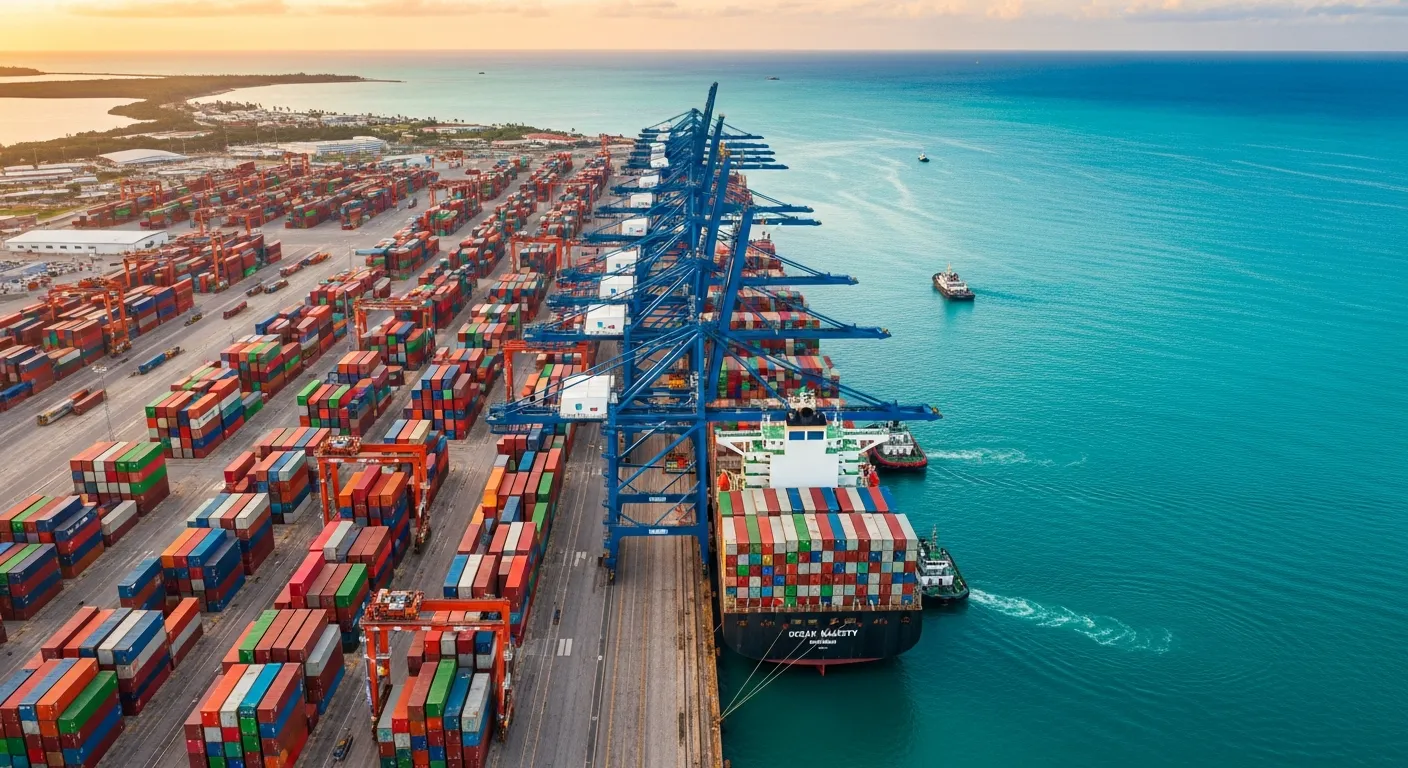
The Caribbean logistics market is a US$4.8 billion ecosystem encompassing ocean freight, port infrastructure, warehousing, customs brokerage, and last-mile delivery across more than 15 island economies. With 9.5 million tonnes of freight moving through the region annually and 7.1 million TEUs of container traffic processed at Caribbean ports in 2024, the sector serves as the critical supply chain backbone for economies that import 80% to 95% of consumed goods — including the $6B+ in annual food imports the region depends on (HRG estimate derived from published UNCTAD and ECLAC port and trade data, 2024).
Caribbean Logistics Market: Key Statistics 2024 to 2025
$4.8B
Total Caribbean logistics market value (ECLAC, World Bank, 2024)
9.5M
Tonnes of freight handled annually across the region (HRG estimate derived from published UNCTAD and ECLAC port and trade data, 2024)
7.1M
TEUs of container traffic at Caribbean ports (HRG estimate derived from published UNCTAD and ECLAC port and trade data, 2024)
1.82M
TEUs handled at Kingston, the region's largest port (Port Authority of Jamaica, 2024)
20-30%
Logistics cost as share of landed product cost (World Bank, 2024)
5.2%
Market CAGR 2019 to 2024 (ECLAC, 2024)
Caribbean Logistics Market Size & Growth Trajectory
The Caribbean freight and logistics market reached an estimated US$4.8 billion in 2024, growing at a compound annual growth rate of 5.2% from the pre-pandemic baseline of US$3.7 billion in 2019 (ECLAC, 2024). This growth trajectory reflects both the recovery from the 2020 pandemic contraction, which saw freight volumes decline by 17% across the region, and structural demand increases driven by e-commerce penetration, cold chain expansion, and growing consumer imports across major Caribbean economies (UNCTAD Review of Maritime Transport, 2024).
The Caribbean logistics market value is distributed across several key segments: ocean freight services account for approximately US$1.82 billion (38% of market), port handling and terminal operations represent US$1.06 billion (22%), customs brokerage and regulatory compliance services total US$864 million (18%), inland transportation and last-mile delivery generate US$576 million (12%), warehousing and distribution contribute US$336 million (7%), and insurance, documentation, and administrative services make up US$144 million (3%) (World Bank Logistics Performance Index, 2024; ECLAC, 2024).
Port Infrastructure & Container Throughput
Caribbean port infrastructure is anchored by three major transshipment hubs that handle the bulk of regional container traffic. For analysis of how cruise and cargo port operations interact, see our Caribbean Cruise Port Economics report. Kingston Container Terminal in Jamaica processed approximately 1.82 million TEUs in 2024, maintaining its position as the Caribbean's premier transshipment hub and one of the busiest ports in the Western Hemisphere. The terminal's strategic location at the intersection of major east-west and north-south shipping lanes, combined with its post-Panamax vessel capacity, makes it a critical node in global container shipping networks (Port Authority of Jamaica, 2024).
DP World's Caucedo terminal in the Dominican Republic handled approximately 1.45 million TEUs in 2024, serving as the primary gateway for the Dominican Republic's rapidly growing consumer import market and an expanding transshipment operation connecting Central American and Caribbean feeder routes (ECLAC Maritime Bulletin, 2024). Freeport Container Port in the Bahamas processed 1.38 million TEUs, leveraging its proximity to the US East Coast to serve as a key transshipment point for North America-Caribbean trade flows (Hutchison Ports, 2024).
Port Throughput by Country, 2024
Loading chart...
| Port | Country | TEUs (2024) | Primary Function | Operator |
|---|---|---|---|---|
| Kingston Container Terminal | Jamaica | 1,820,000 | Transshipment Hub | CMA CGM / Kingston Wharves |
| Caucedo | Dominican Republic | 1,450,000 | Gateway + Transshipment | DP World |
| Freeport Container Port | Bahamas | 1,380,000 | Transshipment Hub | Hutchison Ports |
| Port of Spain | Trinidad & Tobago | 520,000 | Gateway + Regional Hub | PATT |
| San Juan | Puerto Rico | 480,000 | Gateway Port | Puerto Rico Ports Authority |
| Bridgetown | Barbados | 95,000 | Gateway Port | Barbados Port Inc. |
Source: ECLAC Maritime Bulletin, Port Authority of Jamaica, DP World, Hutchison Ports, national port authorities, 2024. TEU figures are estimated based on published throughput data and industry reports.
Caribbean Supply Chain Cost Benchmark Report
Download our logistics cost analysis comparing freight rates, port handling fees, customs clearance times, and last-mile delivery costs covering Jamaica, the Dominican Republic, the Bahamas, Trinidad and Tobago, Puerto Rico, Barbados, and the Eastern Caribbean OECS markets.
Free Caribbean Market Assessment
Discover which research methodology best fits your Caribbean market entry strategy.
Freight Volume Trends & Recovery
Total freight volumes across Caribbean ports reached approximately 9.5 million tonnes in 2024, surpassing the pre-pandemic level of 8.2 million tonnes recorded in 2019 and representing a full recovery from the 6.8 million tonne low of 2020 (HRG estimate derived from published UNCTAD and ECLAC port and trade data, 2024). Containerized cargo accounted for 6.2 million tonnes of the 2024 total, with the remainder consisting of bulk commodities including petroleum products, construction materials, agricultural inputs, and mineral exports from Guyana and Trinidad & Tobago.
The containerized freight segment has grown faster than total freight volumes, reflecting the ongoing shift from break-bulk and bulk shipping to containerization across the Caribbean. This trend has been driven by increased consumer goods imports, growing e-commerce parcel volumes, and the containerization of agricultural exports including bananas, cocoa, and specialty food products from Eastern Caribbean origins (ECLAC Transport Bulletin No. 5/2024).
Caribbean Freight Volume Trends
Loading chart...
Note: Regional freight and container traffic totals are HRG estimates derived from published UNCTAD and ECLAC port and trade data. They are directional indicators, not figures published as regional totals by either institution.
Major Shipping Routes & Trade Corridors
The Caribbean is served by five primary shipping corridors that connect the region to global trade networks. The US East Coast-Caribbean route is the dominant trade lane, with Miami, Jacksonville, and Port Everglades serving as the primary load ports for consumer goods, food products, and manufactured items destined for Caribbean markets. An estimated 65% of all Caribbean-bound containerized imports originate from or transit through South Florida ports, making the Miami-Caribbean corridor one of the most concentrated trade dependencies in global shipping (US Maritime Administration, 2024).
The Panama Canal-Caribbean feeder network has grown in importance following the canal's 2016 expansion, enabling larger vessels to transit and increasing Asia-origin cargo flows through Caribbean transshipment hubs. Kingston and Caucedo serve as the primary relay points for this traffic, with feeder services distributing containers to smaller Caribbean destinations. European services from Rotterdam, Algeciras, and Mediterranean ports provide direct connections for EU-origin goods, while intra-Caribbean feeder networks operated by regional carriers like Tropical Shipping and Crowley connect hub ports to smaller island destinations with limited draft or infrastructure (UNCTAD, 2024).
| Trade Corridor | Key Origin Ports | Caribbean Destinations | Share of Imports |
|---|---|---|---|
| US East Coast-Caribbean | Miami, Jacksonville, Port Everglades | All major Caribbean ports | ~65% |
| Panama Canal Feeder | Asia via Panama Canal | Kingston, Caucedo, Freeport | ~15% |
| Europe-Caribbean | Rotterdam, Algeciras | French Caribbean, Trinidad, Jamaica | ~10% |
| Intra-Caribbean Feeder | Kingston, Trinidad, San Juan | Eastern Caribbean, OECS islands | ~7% |
| South America-Caribbean | Cartagena, La Guaira, Georgetown | Trinidad, Jamaica, Barbados | ~3% |
Source: UNCTAD Review of Maritime Transport, US Maritime Administration, ECLAC, 2024. Import share percentages are estimated based on containerized cargo origin data.
Logistics Cost Analysis: The Island Premium
Logistics costs in the Caribbean represent 20% to 30% of the final landed cost of imported products, significantly exceeding the 8% average in the US mainland and 12% to 15% in mainland Latin America, creating a structural cost disadvantage for Caribbean businesses and consumers (Council of Supply Chain Management Professionals, 2024; Inter-American Development Bank, 2024; World Bank Logistics Performance Index, 2024). This "island premium" is driven by low cargo volumes that reduce economies of scale, limited port infrastructure requiring multiple transshipments, high fuel costs for inter-island distribution, and customs procedures that add time and cost to supply chains.
Ocean freight represents the largest single cost component at 38% of total logistics spend, reflecting the Caribbean's near-total dependence on maritime transport for goods imports. Port handling costs at 22% are elevated by congestion at smaller ports, limited mechanization, and shorter operating hours compared to major international terminals. Customs and regulatory compliance costs at 18% are driven by the complex duty structures, documentation requirements, and inspection protocols that vary across Caribbean jurisdictions.
Caribbean Logistics Cost Breakdown
Loading chart...
Logistics Cost Comparison: Caribbean vs. Mainland Markets
- Caribbean SIDS average: 20% to 30% of landed product cost (World Bank, 2024)
- US mainland average: 8% of product cost (Council of Supply Chain Management Professionals, 2024)
- Latin America mainland average: 12% to 15% of product cost (Inter-American Development Bank, 2024)
- Eastern Caribbean small islands: Up to 35% of landed cost for outer islands (Caribbean Development Bank, 2024)
- Shipping a 20ft container Miami to Kingston: ~US$1,800 to US$2,400 (Freightos, 2024)
- Shipping a 20ft container Miami to Dominica: ~US$3,200 to US$4,500 (Freightos, 2024)
Container Traffic Growth & Transshipment Dynamics
Regional container traffic reached 7.1 million TEUs in 2024, growing from an estimated 5.8 million TEUs in 2019, a compound annual growth rate of 4.1% on those estimates (HRG analysis). Transshipment cargo accounts for approximately 60% of total Caribbean container movements, with Kingston, Freeport, and Caucedo functioning as relay points in global shipping networks rather than purely serving domestic import-export demand. This transshipment function has been a critical driver of port investment and infrastructure development across the region.
The Panama Canal expansion has reshaped Caribbean transshipment patterns, enabling Neo-Panamax vessels of up to 14,000 TEUs to transit the canal and discharge cargo at Caribbean hub ports for redistribution via smaller feeder vessels. Kingston Container Terminal has invested over US$600 million in terminal expansion and dredging to accommodate these larger vessels, deepening the port's competitive position against rival transshipment hubs at Cartagena, Colombia and Balboa, Panama (Port Authority of Jamaica, 2024; Caribbean Maritime Institute, 2024).
Caribbean Container Traffic Growth
Loading chart...
Note: Regional freight and container traffic totals are HRG estimates derived from published UNCTAD and ECLAC port and trade data. They are directional indicators, not figures published as regional totals by either institution.
Cold Chain Logistics: A Growing Imperative
Cold chain logistics represents one of the fastest-growing segments of the Caribbean logistics market, valued at approximately US$420 million in 2024 and growing at 7.8% annually (Caribbean Development Bank, 2024). The segment encompasses refrigerated container transport, cold storage warehousing, temperature-controlled last-mile delivery, and pharmaceutical distribution requiring strict temperature compliance. Caribbean economies import an estimated 60% to 80% of food products consumed, with perishable categories including dairy, meat, fresh produce, and frozen foods requiring unbroken cold chain integrity from origin to retail shelf (FAO, 2024).
Cold storage capacity across the Caribbean remains limited relative to demand, with total regional capacity estimated at approximately 850,000 cubic meters, of which Jamaica accounts for 28%, Trinidad & Tobago for 22%, and Puerto Rico for 35% (Caribbean Development Bank, 2024). Smaller Eastern Caribbean islands face acute cold storage shortfalls, with facilities often operating at 90% to 95% capacity during peak seasons. This infrastructure gap leads to food waste rates of 15% to 25% for perishable imports, representing both a cost burden on consumers and a market opportunity for cold chain infrastructure investors (FAO Caribbean Office, 2024).
Last-Mile Delivery Challenges & Innovation
Last-mile delivery in the Caribbean faces structural challenges that are unique among global logistics markets. Dispersed populations across multiple islands, limited road infrastructure, informal addressing systems in many territories, and high fuel costs combine to make Caribbean last-mile delivery 2.5 to 4 times more expensive per package than comparable mainland operations (World Bank, 2024). In markets like Jamaica, where only 65% of roads are paved and mountainous terrain limits direct routing, last-mile costs can represent 40% to 50% of total delivery expense (National Works Agency Jamaica, 2024).
Innovation in Caribbean last-mile delivery is being driven by e-commerce growth and the entry of regional logistics startups. Companies like Knutsford Express in Jamaica, Caribbean Courier Solutions, and island-specific operators are developing hybrid delivery models that combine traditional courier networks with pickup point infrastructure, locker systems at retail locations, and community delivery hubs in rural areas. These models address the addressing challenge by using GPS coordinates and mobile phone-based delivery confirmation rather than relying on formal street addresses that may not exist in many Caribbean communities (Caribbean Development Bank, 2024).
E-Commerce Logistics & Cross-Border Fulfillment
E-commerce logistics has emerged as the fastest-growing segment of the Caribbean logistics market, driven by substantial growth in online retail penetration from pre-pandemic levels. Caribbean consumers increasingly purchase from US-based e-commerce platforms including Amazon, Walmart, and specialty retailers, creating demand for cross-border fulfillment, package consolidation, and duty management services.
Miami-based freight forwarders and consolidators have become critical infrastructure for Caribbean e-commerce, processing an estimated 2.3 million packages annually for Caribbean-bound shipments (Caribbean Development Bank, 2024). Services like mailbox forwarding addresses, package consolidation, duty pre-calculation, and delivered-duty-paid shipping have become standard offerings from companies including Mailpac, Zippy Jamaica, and FedEx Caribbean. These consolidators reduce per-package shipping costs by 30% to 50% compared to individual parcel shipments by combining multiple consumer orders into containerized or palletized shipments for ocean freight (IMF Caribbean Regional Outlook, 2024).
| Logistics Segment | Market Value (2024) | Growth Rate | Key Driver |
|---|---|---|---|
| Ocean Freight | US$1.82B | 4.5% CAGR | Import volume growth |
| Port & Terminal Operations | US$1.06B | 5.0% CAGR | Transshipment expansion |
| Cold Chain Logistics | US$420M | 7.8% CAGR | Food import dependence |
| E-Commerce Fulfillment | US$310M | 12.5% CAGR | Online retail penetration |
| Warehousing & Distribution | US$336M | 4.8% CAGR | Free zone development |
Source: ECLAC, World Bank, Caribbean Development Bank, IMF, 2024. Market values are HRG estimates based on published trade, port, and logistics data.
Future Outlook: Digital Transformation & Infrastructure Investment
The Caribbean logistics market is poised for significant transformation driven by three converging trends: digital customs and trade facilitation modernization, port infrastructure investment exceeding US$2 billion in committed projects through 2028, and the rapid growth of e-commerce-driven logistics demand. Jamaica's National Logistics Hub Initiative, which aims to position the country as a fourth global logistics node alongside Singapore, Dubai, and Rotterdam, represents the most ambitious infrastructure program in the region with US$8 billion in projected investment over 15 years (Government of Jamaica, 2024).
Digital trade facilitation, including single-window customs systems, electronic bills of lading, and blockchain-based cargo tracking, is being piloted across several Caribbean jurisdictions with support from the World Bank and Inter-American Development Bank. Trinidad & Tobago's TTBizLink and Jamaica's ASYCUDA World systems are reducing customs clearance times from an average of 5 to 7 days to 2 to 3 days in participating territories, directly lowering logistics costs and improving supply chain reliability (World Bank Trade Facilitation Support Program, 2024).
For logistics providers, freight forwarders, port operators, and supply chain investors operating in the Caribbean, the key strategic considerations include the pace of customs modernization, cold chain infrastructure development opportunities, the growing e-commerce fulfillment segment, and the competitive dynamics among Caribbean transshipment hubs competing for Asia-Americas relay traffic. Hope Research Group tracks these trends across 30+ Caribbean and Latin American markets to support data-driven logistics planning and market entry strategy.
HRG Research Capabilities in Caribbean Logistics Markets
Hope Research Group supports shipping lines, port operators, freight forwarders, e-commerce platforms, cold chain operators, and supply chain investors operating across Caribbean logistics markets. Our research capabilities include market sizing and demand forecasting, trade flow analysis, port competitiveness benchmarking, last-mile delivery consumer preference studies, and competitive landscape assessments across ocean freight, warehousing, and customs brokerage segments.
For businesses planning market entry, infrastructure investment, or service expansion in the Caribbean logistics sector, HRG provides primary research that quantifies freight demand, cost structures, service gaps, and competitive positioning across relevant markets. Our field research teams operate across Jamaica, Trinidad & Tobago, Barbados, the Dominican Republic, Puerto Rico, the Bahamas, and Eastern Caribbean OECS markets, delivering the on-the-ground intelligence that secondary data sources alone cannot provide.
Frequently Asked Questions
What is the size of the Caribbean logistics market?
The Caribbean logistics market is valued at approximately US$4.8 billion in 2024, encompassing ocean freight, port handling, warehousing, inland transportation, customs brokerage, and last-mile delivery services. The market has grown at a CAGR of 5.2% from 2019 to 2024 (ECLAC, 2024; World Bank, 2024).
Which Caribbean ports handle the most container traffic?
Kingston, Jamaica leads with 1.82 million TEUs in 2024, followed by Caucedo, Dominican Republic at 1.45 million TEUs, and Freeport, Bahamas at 1.38 million TEUs. These three transshipment hubs handle the majority of Caribbean container traffic (ECLAC Maritime Bulletin, 2024; Port Authority of Jamaica, 2024).
What are the main shipping routes serving the Caribbean?
Five primary corridors serve the Caribbean: the US East Coast-Caribbean route (~65% of imports), Panama Canal feeder network (~15%), Europe-Caribbean services (~10%), intra-Caribbean feeder networks (~7%), and South America-Caribbean routes (~3%). Miami, Jacksonville, and Port Everglades are the dominant origin ports for Caribbean-bound cargo (UNCTAD, 2024).
How much does logistics cost in the Caribbean compared to other regions?
Logistics costs represent 20% to 30% of landed product cost in the Caribbean, compared to 8% in the US and 12% to 15% in mainland Latin America. Small island economies face costs 2 to 3 times higher per unit than continental destinations due to low volumes, limited infrastructure, and multiple transshipment requirements (World Bank, 2024; ECLAC, 2024).
How is e-commerce affecting Caribbean logistics?
E-commerce is transforming Caribbean logistics, with online retail penetration growing substantially from pre-pandemic levels. Miami-based consolidators process 2.3 million packages annually for Caribbean-bound e-commerce, while last-mile delivery innovation including pickup points and GPS-based delivery is addressing the region's addressing challenges (Caribbean Development Bank, 2024).
Caribbean Market Intelligence
Monthly research insights, consumer trends data, and industry analysis from 30+ Caribbean and Latin American markets.
Need Caribbean Logistics Market Intelligence?
Hope Research Group provides trade flow analysis, port benchmarking, last-mile delivery research, and competitive landscape assessments for shipping lines, freight forwarders, port operators, and supply chain investors operating across Caribbean markets.
From cold chain infrastructure gap analysis and e-commerce fulfillment demand forecasting to customs modernization impact assessments and transshipment hub competitive dynamics, we deliver the on-the-ground market intelligence that informs better logistics decisions across 30+ Caribbean and Latin American markets.
Speak to Our Logistics Research TeamRelated Research
Explore more industry deep-dives and market intelligence from Hope Research Group covering Caribbean and Latin American markets.
Caribbean E-Commerce Market
Online retail growth, cross-border fulfillment, and digital payment adoption across the Caribbean
Caribbean Food Import Analysis
Food import volumes, cold chain requirements, and supply chain dependencies across island economies
Caribbean Construction Market Trends
Construction material logistics, port infrastructure projects, and building supply chain analysis
Caribbean FMCG Market Analysis
FMCG distribution channels, trade logistics, and consumer goods supply chain across the Caribbean
Caribbean Supply Chain Insights
Supply chain optimization, trade data, and distribution network analysis for Caribbean businesses
Caribbean Automotive Market Trends
Vehicle import logistics, Japanese used car pipeline, and automotive supply chain across the region
Caribbean Cruise Port Economics
$1.1B+ port infrastructure investment, revenue structures, and employment data across Caribbean cruise destinations