Caribbean Food Import Analysis 2026: $6.2B Market Breakdown
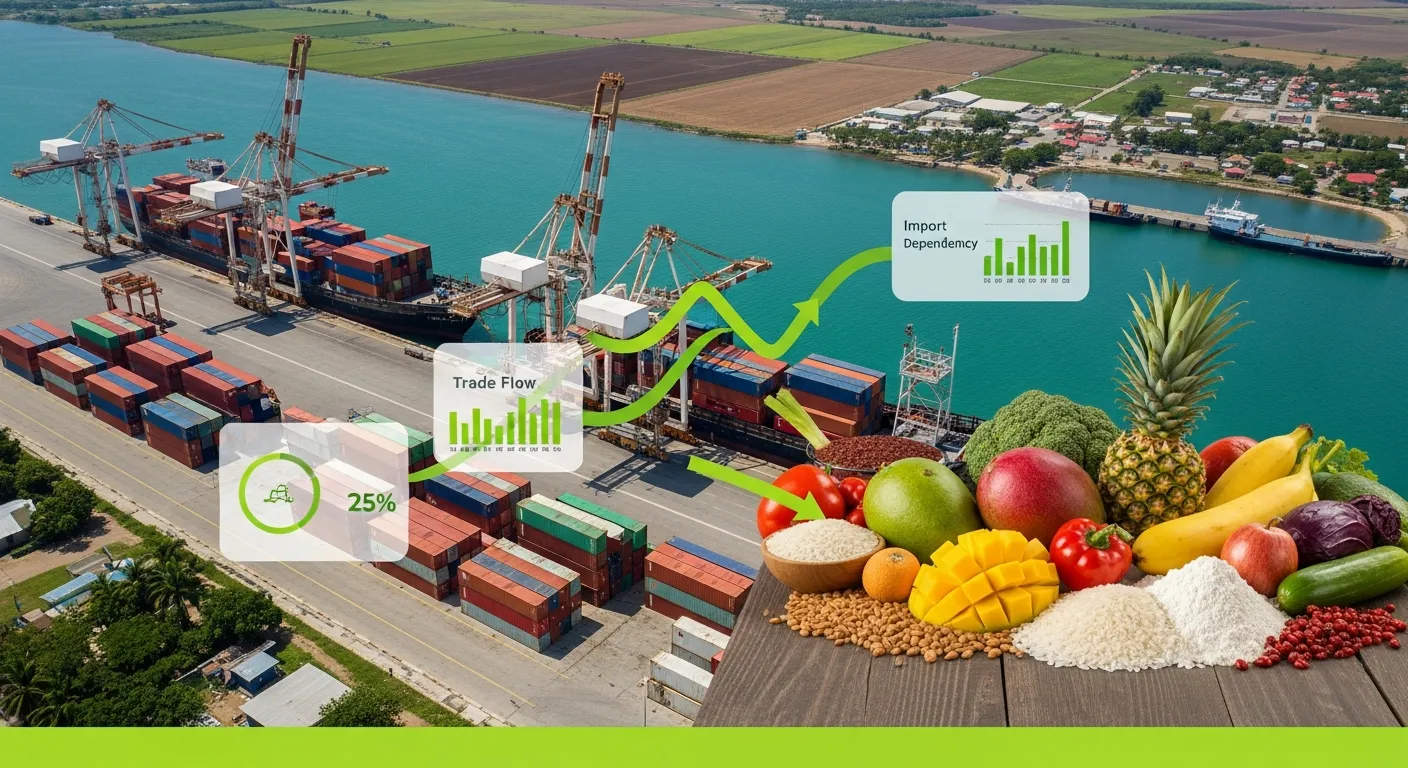
The Caribbean imports more than 60% of the food it consumes, generating an annual bill exceeding USD 6 billion for CARICOM member states alone. This structural dependency, rooted in colonial trade patterns and deepened by tourism-driven demand, leaves Caribbean populations exposed to global commodity shocks, shipping disruptions, and the intensifying damage of Atlantic hurricanes. The crisis became viscerally visible in July 2024 when Hurricane Beryl devastated Jamaica's agricultural sector, destroying over USD 6.4 million in crops and impacting nearly 50,000 farmers (Jamaica Ministry of Agriculture, 2024).
Need primary data?
HRG conducts custom research on food import distribution, retail audits, and consumer purchasing behavior across Caribbean. Get a scoped quote within 24 to 48 hours.
Caribbean Food Imports: Key Statistics 2024
$6B+
CARICOM annual food import bill, targeted for 25% reduction under Vision 25x2030 (CARICOM Secretariat, 2025)
60-80%
Share of food consumed that is imported across CARICOM member states; some markets exceed 90% (FAO/CARICOM, 2024)
49%
US share of consumer-oriented agricultural product imports to the Caribbean Basin in 2024 (USDA FAS, 2025)
$1.3B
Jamaica's total food and beverage imports in 2024, with the US supplying approximately 40% (USDA/STATIN, 2025)
$2B
US processed food exports to the Caribbean in 2024, a record high and first time over $2 billion (USDA FAS, 2025)
$10.2B
Packaged food retail market size across the Caribbean in 2024, forecast at $14.2B by 2029 (Euromonitor, 2025)
Working on a food trade analysis, market entry assessment, or supply chain study for the Caribbean? We provide primary fieldwork to complement these figures: retail audits, import channel mapping, consumer purchase panels, and distributor interviews. Book a call with our team.
Food Import Dependency by Country, 2024
Loading chart...
The Scale and Structure of Caribbean Food Dependency
Food import dependency across the Caribbean is not a recent phenomenon. Colonial plantation economies redirected land away from subsistence agriculture toward export cash crops, creating a reliance on imported staples that has compounded over two centuries. CARICOM Secretary-General Dr. Carla Barnett, speaking at the Caribbean Investment Forum in November 2022, stated directly that structural characteristics of Caribbean economies meant the region imports more than 60% of the food it eats, with some countries importing more than 80%. That structural reality has not materially improved in the years since.
The US Food and Agriculture Service (FAS) Caribbean Basin Agricultural Trade Office in Miami reported in 2025 that US processed food exports to the Caribbean reached USD 2 billion in 2024, a record high and the first time that threshold has been crossed. Total consumer-oriented agricultural product imports to the region reached USD 3 billion in 2023, with the United States capturing 49% of market share. The broader retail food sector across the Caribbean was valued at USD 10.2 billion in 2024 by Euromonitor International, with a forecast of USD 14.2 billion by 2029 driven by a projected 30.3% growth rate over five years.
Tourism amplifies import volumes significantly. Approximately 82% of imported foods and beverages are channeled through the retail sector, but the hotel, restaurant, and institutional (HRI) channel is the single largest driver of premium food imports across most island markets. In Jamaica, approximately 60% of food imports are destined for the HRI sector rather than household consumption (USDA FAS, 2025). In the Cayman Islands, the hotel and restaurant sector grew by 12.6% in 2024 alone and drives a disproportionate share of what is now 90% food import dependency. The tourism-food import nexus means that as Caribbean tourism reaches record highs, import volumes rise in tandem, deepening rather than resolving the structural imbalance.
What the Caribbean Imports and From Whom
The five largest import categories for the Caribbean Basin are dairy products, poultry meat and products (excluding eggs), bakery products, soups and other prepared foods, and beef and beef products. These five categories alone represent approximately one-third of all consumer-oriented product imports (USDA FAS, 2024). The United States holds leading market share in practically every product category, drawing on geographic proximity, established South Florida consolidator networks, and long-standing brand recognition that has been reinforced by Caribbean tourism and diaspora connections.
Poultry is a particularly instructive case study. Chicken is the primary source of protein across most Caribbean markets, and demand is high. In Jamaica, strict import duties protect domestic production for whole birds, but imported chicken backs and necks enter duty-free and are widely consumed by lower-income households. US poultry exports to Jamaica remain the largest agricultural export category to the island. The Dominican Republic has been shifting further toward poultry as beef and pork prices rise locally, and the full elimination of all tariffs on US exports to the DR as of January 2025 under CAFTA-DR is expected to accelerate this trend.
Top Food Import Categories, Caribbean Basin (US$ Billions)
Loading chart...
Wheat flour is a core staple across the anglophone Caribbean, with Jamaica ranking among the world's highest per capita consumers of flour-based products. Two milling facilities operate in Jamaica, both with significant US company ownership, reinforcing the supply chain link to North American grain markets. Rice is another essential staple, though increasingly it is supplied by regional producers led by Guyana, which exported 425,490 metric tonnes of rice and by-products to 30 countries in 2024, valued at USD 254 million (Guyana Ministry of Agriculture, December 2024).
| Market | Food Import Dependency | Annual Import Value (Approx.) | Primary Suppliers | Key Import Categories |
|---|---|---|---|---|
| Jamaica | ~60% by value | $1.3B (2024) | US (40%), T&T, Canada | Poultry, wheat flour, dairy, oils, cereals |
| Dominican Republic | ~50-60% | $2.2B from US alone (2024) | US (largest supplier), Brazil, EU | Meat, dairy, bakery, soy, animal feed |
| Trinidad and Tobago | Over 80% | Substantial (petro-income funded) | US, Brazil, Costa Rica, Guatemala | Grains, processed foods, fresh produce |
| Bahamas | ~90% | High (tourism-driven) | US (~80%), Canada, EU | All food categories; minimal domestic production |
| Cayman Islands | Over 90% | $136.8M from US alone (2024) | US (~80%), through US ports | Meat, processed foods, dairy, fresh produce |
| Guyana | Net food exporter | $254M rice exports (2024) | Exports to 30 countries | Rice, sugar, non-traditional commodities |
US Agricultural Exports to Caribbean Basin, 2019-2024 (US$ Billions)
Loading chart...
Need Caribbean Food Trade Intelligence?
Retail audits, consumer purchase panels, import channel mapping, and distributor interviews. Our fieldwork covers CARICOM member states and the wider Caribbean basin.
Intra-Regional Trade: The Persistent Missed Opportunity
Despite decades of integration rhetoric, intra-CARICOM food trade remains remarkably thin, estimated at 5 to 10% of total food imports. The region imports its own products from the United States rather than from neighboring islands. Trinidad and Tobago, which has a more developed food processing sector than most CARICOM members, accounts for a disproportionate share of intra-regional processed food trade, but even this relationship operates largely as a re-export and secondary manufacturing hub rather than as a primary food supplier. The structural barriers are significant: varying phytosanitary standards across island regulatory bodies, poor maritime logistics between smaller islands, and limited cold chain infrastructure.
Guyana represents the most significant unrealized intra-regional supply opportunity. A 2024 study published in Nature Food by researchers at the University of Göttingen and the University of Edinburgh identified Guyana as the only country among 186 assessed that achieves complete food self-sufficiency, producing sufficient agricultural output to meet the full nutritional needs of its population while still exporting. In 2024, Guyana exported 425,490 metric tonnes of rice and by-products to 30 countries, totaling USD 254 million, and it exported non-traditional commodities valued at USD 1.8 billion in 2023 (Guyana Ministry of Agriculture, 2025). The Caribbean Development Bank is financing a study to establish a maritime cargo service linking Barbados, Grenada, Guyana, and Trinidad to improve regional food supply logistics, and a Guyana-Barbados food terminal is under construction as of early 2025.
The contrast between Guyana's agricultural abundance and Cayman's 90% import dependency illustrates the structural mismatch at the core of CARICOM's food challenge. Guyana has dramatically increased production across commodities: rice output rose from 569,789 metric tonnes in 2021 to a record 725,282 metric tonnes in 2024, an increase of 27% over three years. The country is on track for self-sufficiency in corn, soya, red beans, and black-eyed peas, and intends to supply regional CARICOM needs for several of these commodities by 2025 to 2027 (Guyana Ministry of Agriculture, 2024). Translating Guyana's production surplus into affordable regional food supply remains the central logistics and policy challenge for CARICOM food security.
Local Agriculture and Agro-Processing Capacity
Domestic food production and processing capacity is uneven across the Caribbean. Food processing is concentrated in Jamaica, the Dominican Republic, and Trinidad and Tobago, which between them account for the majority of the region's agro-industrial output. In Jamaica, the Central Bank of the DR valued the Dominican food processing industry at USD 3 billion as of September 2024, while Jamaica's USDA-FAS profile noted that 70% of raw materials used by local food processors are imported, with only 30% sourced domestically.
GraceKennedy Limited is the Caribbean's leading agro-processing and food manufacturing conglomerate, operating six manufacturing facilities in Jamaica and exporting Grace-branded products to the US, UK, Canada, and Ghana. GraceKennedy's Grace Agro Processors division produces pepper mash in St Elizabeth, operates contract farming programs with local pepper, vegetable, and fruit growers, and distributes both its own and international brands through a network of over 60 subsidiaries. The company represents the Caribbean's most advanced example of vertically integrated food manufacturing linked to local agricultural supply chains.
Caribbean Producers Jamaica (CPJ), a major food distributor and processor, has positioned itself explicitly as an import substitution vehicle, stating publicly that it is shifting toward developing local vertical supply chains and sourcing locally for categories including pork, tilapia, and fresh produce. Seprod Group operates a significant palm oil and food products manufacturing operation in Jamaica, while the Wisynco Group distributes approximately 4,000 product lines to retail and institutional customers. Trinidad's Angostura Holdings and Banks DIH in Guyana are the other two largest agro-processing entities with regional distribution reach.
Food Price Dynamics and Consumer Impact
Import dependency creates direct pass-through exposure to global commodity price movements. When global wheat, edible oil, or soy prices spike, Caribbean consumers experience rapid food inflation because domestic production capacity is insufficient to buffer the shock. Caribbean small states recorded consumer price inflation of 2.57% in 2024, down from higher pandemic-era peaks, according to World Bank data compiled by the St. Louis Federal Reserve. However, food-specific inflation is typically higher than headline CPI in import-dependent economies where energy and logistics costs are embedded in food prices.
Food Price Inflation by Country, 2024
Loading chart...
The 2022 Russia-Ukraine war provided a vivid illustration of this vulnerability. Wheat and edible oil prices spiked globally following the conflict's disruption of Black Sea grain routes. Caribbean consumers absorbed price increases across bread, flour-based products, and cooking oil within weeks. Trinidad and Tobago, which imports more than 80% of calories consumed, had to charter emergency grain deliveries during the pandemic era when shipping routes collapsed, according to analysis published by the Latin American Post in July 2025. Jamaica's hotels continue to source lettuce from California rather than from Caribbean farms, a practice that became conspicuous when shipping disruptions and produce shortages converged in 2020 and 2021.
For lower-income Caribbean households, food expenditure represents a larger share of total household spending than in high-income countries, making food inflation disproportionately damaging. The shift in dietary patterns toward imported processed foods has also introduced nutritional vulnerability. USDA data on the Cayman Islands shows that over the past 10 years, imports of processed and prepared meats from the US rose by more than 1,700%, while poultry imports grew 201% and beef imports grew more than 70%. This pattern of trading traditional subsistence diets for imported processed foods is replicated to varying degrees across the archipelago.
Climate Resilience and the Hurricane Beryl Test Case
Jamaica's agricultural sector suffered its most severe recent crisis when Hurricane Beryl passed just south of the island as a Category 4 storm on July 3 to 4, 2024. The storm delivered wind speeds up to 130 mph and between 8 and 12 inches of rainfall, with a storm surge that flooded coastal agricultural areas. Jamaica's Agriculture Minister Floyd Green described St Elizabeth, the island's primary agricultural parish and historically called the breadbasket of Jamaica, as suffering "complete devastation."
Formal assessments confirmed the scale: 48,852 farmers were impacted, 23,040 hectares of farmland were damaged, and total agricultural sector losses reached J$4.73 billion (approximately USD 30 million), including the loss of 323,412 animals spanning poultry, small ruminants, and cattle (Jamaica Ministry of Agriculture, July 2024). The Rural Agricultural Development Authority (RADA) estimated 45,000 farmers affected with USD 15.9 million in infrastructure damage. Banana and plantain production in Portland and St Mary collapsed, with approximately 85% of those crop lines destroyed. Domestic crop shortages in cabbage, callaloo, sweet peppers, yams, plantains, and cassava persisted throughout the remainder of 2024 (USDA FAS, 2025). The hurricane contributed to a 1.9% contraction in Jamaica's GDP compared to 2023, according to the Planning Institute of Jamaica's December 2024 report.
The Beryl event underscores why import dependency is not merely an economic concern but a food security one. A country that relies on imports for 60% of its food can still maintain supply through external sourcing even after domestic agriculture is devastated. But the capacity to pay for that substitute supply depends on foreign exchange generation, which itself depends heavily on tourism, a sector equally vulnerable to hurricane disruption. The circularity of this vulnerability creates systemic fragility that CARICOM's Vision 25x2030 initiative is designed to address.
Vision 25x2030: Progress and Challenges
- ●At the 48th CARICOM Heads of Government meeting in Barbados, February 2025, the original 2025 deadline was extended to 2030, acknowledging Hurricane Beryl's disruption of Eastern Caribbean agriculture and ongoing supply chain pressures (CARICOM Secretariat, 2025).
- ●President Irfaan Ali of Guyana, the Lead Head of Government for agriculture and food security, reported approximately 24% growth in regional food production from 2022 through late 2024, crediting investment in staple crop production and the CARICOM Agri-Food Systems Strategy (CARICOM, February 2025).
- ●The revised initiative adds expanded stakeholder participation, an agricultural insurance product, greater private sector investment, and the removal of barriers to intra-regional agricultural trade as core implementation pillars.
- ●Priority commodities include poultry, corn, soya, goat and sheep meat, beef, rice, and niche vegetables, reflecting the highest-value import categories targeted for regional substitution (CARICOM Agribusiness Development Programme, 2024).
- ●Guyana's agricultural expansion is the initiative's most concrete supply-side success: rice output reached a record 725,282 metric tonnes in 2024, and Guyana is on track to supply CARICOM's full corn and soya requirements by 2027 (Guyana Ministry of Agriculture, 2025).
Market Opportunities for Investors and Researchers
Caribbean food import dependency generates specific and substantial commercial opportunities across several segments. Agro-processing investment targeting import substitution is among the most compelling: the Jamaican government's network of six planned agro-processing centres, anchored by partnerships with GraceKennedy and Caribbean Producers Jamaica, offers a structured entry point for investors in food manufacturing, cold chain infrastructure, and packaging. Companies that can process Caribbean-grown inputs into shelf-stable finished goods address two problems simultaneously: reducing import dependence and creating higher-value agricultural supply chain employment.
Intra-regional food logistics represents a structural gap with significant addressable value. The Caribbean Development Bank's maritime cargo service study for the Barbados-Grenada-Guyana-Trinidad corridor is an early institutional acknowledgment that the region lacks the shipping infrastructure to move food efficiently between its own production surpluses and import-dependent markets. Investors in cold storage, maritime logistics, and port handling infrastructure stand to benefit from both CARICOM policy support and underlying demand growth.
For market research professionals, Caribbean food import dynamics present a rich intelligence opportunity. Consumer behavior research tracking substitution patterns between imported and locally produced food, price sensitivity studies at different income brackets, food safety preference research for HRI procurement decisions, and supply chain mapping for agro-processing investors all represent high-value research deliverables. Retailers, food manufacturers, and regional development institutions each require evidence-based intelligence to navigate a food system under structural reform.
Commercial Intelligence Opportunities in Caribbean Food Trade
- ●Consumer preference research distinguishing willingness to pay for locally produced versus imported equivalents, segmented by product category, income bracket, and island market.
- ●HRI procurement decision research tracking how hotels and restaurants select food suppliers, quality standards applied to local produce, and price premiums accepted for Caribbean-grown inputs.
- ●Retail audit and trade audit studies measuring shelf presence, price positioning, and stockout frequency for locally produced versus imported food categories across supermarket chains and independent retailers.
- ●Agro-processing feasibility research identifying which import-substitution categories have sufficient domestic agricultural raw material supply, consumer demand, and competitive cost structures to support local manufacturing.
- ●Post-hurricane impact tracking studies measuring agricultural recovery timelines, consumer behavior during food shortage periods, and long-term brand loyalty effects when local supply chains are disrupted.
Caribbean Market Intelligence
Monthly research insights, consumer trends data, and industry analysis from 30+ Caribbean and Latin American markets.
Need Food Trade Intelligence for Caribbean Markets?
Hope Research Group conducts consumer preference studies, retail audit research, agro-processing feasibility analysis, and food security impact assessments across 20 Caribbean markets. Our field teams operate across Jamaica, the Dominican Republic, Trinidad and Tobago, Barbados, the Eastern Caribbean, and beyond.
Request a ProposalRelated Research
Caribbean Food and Beverage Market
The $2.89B Caribbean F&B market, including GraceKennedy, Wisynco, rum exports, and regional manufacturing dynamics.
Caribbean Construction Market Trends
Cold storage, food processing plant construction, and agro-industrial infrastructure development across the region.
Jamaica Consumer Trends 2025
Jamaican household food spending patterns, brand loyalty to imported versus domestic products, and supermarket channel dynamics.
Dominican Republic Consumer Trends 2025
DR food consumption patterns, the $3B food processing industry, and US agricultural trade post-CAFTA-DR full implementation in 2025.
Caribbean Renewable Energy Market
Energy costs embedded in Caribbean food production and import logistics, and solar adoption by agro-processors reducing operational cost.
Caribbean Tourism and Hospitality Trends
How record-breaking 2024 tourism arrivals are amplifying HRI sector food import demand across Jamaica and the broader Caribbean.
Related Services
Prefer a PDF copy of this report? Enter your work email and we will send one across.
Download the Caribbean Food Import Analysis Report
Detailed data on import volumes, trade partners, food dependency ratios, retail channel breakdown, and policy context for Caribbean food trade.