Suriname Consumer Trends 2026: $4.5B Economy & Oil Boom
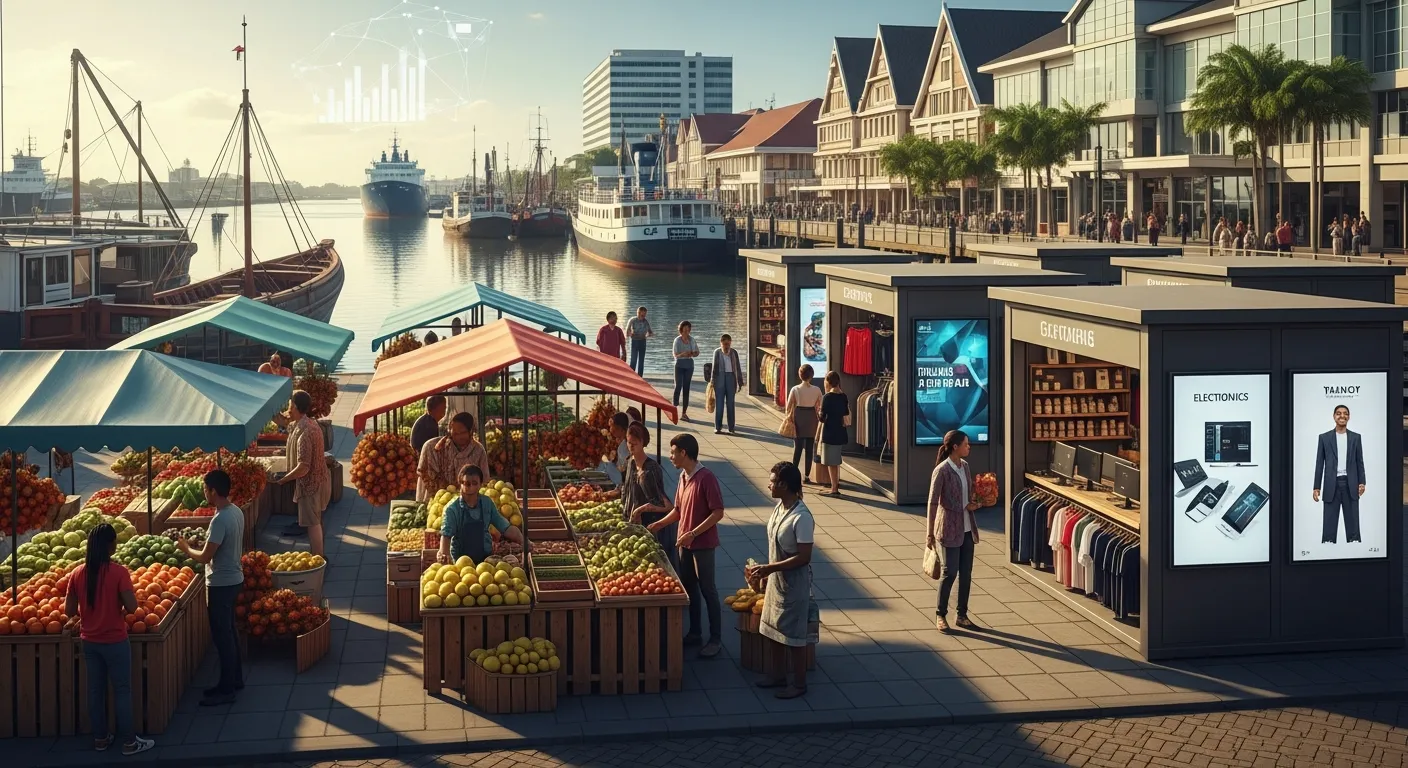
Suriname is a resource-dependent economy with a $4.5B GDP (World Bank, 2025) and 634K population (World Bank, 2024), making it one of the smallest yet most ethnically diverse consumer markets in the Caribbean basin. As the only Dutch-speaking nation in South America, Suriname occupies a unique linguistic and cultural position. Gold mining, bauxite, and petroleum drive the economy, while a 33% informal sector share makes traditional market measurement exceptionally challenging. With 36% GDP growth versus 2023 (World Bank), Suriname is experiencing a resource-driven economic boom that is reshaping consumer spending patterns.
Suriname Consumer Market Key Statistics 2025
634K
Population (World Bank, 2024)
$4.5B
GDP (World Bank, 2025)
$7,070
GDP per capita (World Bank NY.GDP.PCAP.CD, 2025)
36%
GDP growth vs 2023 (World Bank)
33%
Informal economy share
28.9
Median age
Ethnic Diversity & Consumer Segmentation
Suriname's consumer market is uniquely shaped by its multi-ethnic society. Understanding these demographic segments is essential for any brand entering the market, as food preferences, cultural traditions, and purchasing patterns vary significantly across communities.
| Ethnic Group | % of Population | Key Consumer Characteristics |
|---|---|---|
| Hindustani | 27% (General Bureau of Statistics) | Indian-origin, strong spice/curry demand, Bollywood influence |
| Maroon | 22% (General Bureau of Statistics) | African-descent, interior communities, traditional products |
| Creole | 16% (General Bureau of Statistics) | Urban Paramaribo, mixed heritage, modern retail adopters |
| Javanese | 14% (General Bureau of Statistics) | Indonesian-origin, unique food preferences, agricultural ties |
| Mixed/Other | 21% (General Bureau of Statistics) | Including Indigenous (4%), Chinese (2%), diverse preferences |
Shopping Channel Preferences
Suriname's retail landscape reflects its developing economy and concentrated urban population. Paramaribo, home to approximately half the country's population (General Bureau of Statistics), contains the vast majority of modern retail infrastructure. Outside the capital, traditional markets and small shops dominate, with the interior Maroon and Indigenous communities relying on local traders and periodic market visits.
| Channel | Market Share | Key Players | Growth Trend |
|---|---|---|---|
| Traditional/Small Shops | 35% | Independent operators, neighborhood stores | Stable |
| Supermarkets | 25% | Fernandes, Kirpalani's, TonTon | Growing |
| Chinese-Owned Mini-Markets | 20% | Extensive network across Paramaribo | Growing |
| Open-Air Markets | 12% | Central Market Paramaribo, regional markets | Stable |
| Online/Other | 8% | Emerging e-commerce, social media sales | Emerging |
Free Caribbean Market Assessment
Discover which research methodology best fits your Caribbean market entry strategy.
Top Brand Categories & Preferences
Food & Grocery
Suriname's food market reflects its extraordinary ethnic diversity. Hindustani consumers drive demand for Indian spices, roti ingredients, and curry products. Javanese communities maintain preferences for Indonesian-style foods including nasi goreng and bami ingredients. Fernandes Group is the dominant local food and beverage conglomerate, producing soft drinks, dairy products, and snacks. Dutch imports (Unilever, FrieslandCampina) hold strong positions due to colonial ties and Dutch-language packaging compatibility.
Beverages
Parbo Bier (Surinaamse Brouwerij, owned by Heineken) is Suriname's iconic national beer brand. Fernandes produces popular local soft drinks including Fernandes Cherry Bouquet. Dutch beer brands (Heineken, Amstel) benefit from cultural familiarity. The Hindustani community drives significant demand for mango lassi and traditional beverages, while the Javanese community favors Indonesian-style drinks.
Retail & Consumer Goods
Kirpalani's is Suriname's oldest and most recognized department store chain, catering to the Hindustani community and broader urban market. Dutch consumer brands (Douwe Egberts coffee, Verkade biscuits, Calvé condiments) maintain strong market positions due to historical Dutch colonial ties. Brazilian and Chinese imports are increasingly competitive on price, particularly in electronics and textiles.
Generational Consumer Divide
| Generation | % Online Shopping | Preferred Channel | Key Behaviors |
|---|---|---|---|
| Gen Z (18-24) | 35% | Social media, WhatsApp commerce | Dutch + English media, global brand aspirations |
| Millennials (25-40) | 22% | Supermarkets + small shops | Price-sensitive, ethnic food preferences, emerging digital |
| Gen X (41-56) | 10% | Traditional markets, supermarkets | Brand loyal, ethnic community-driven, cash-based |
| Baby Boomers (57+) | 3% | Markets, neighborhood shops | Traditional, relationship-based, Dutch brand loyalty |
Resource Economy & Consumer Impact
Suriname's economy is heavily dependent on natural resources, gold mining, bauxite extraction, and petroleum production account for the majority of export earnings and government revenue. The 36% GDP growth versus 2023 (World Bank) reflects a commodity boom, particularly in gold prices. However, this resource dependency creates consumer spending volatility tied to global commodity cycles.
Gold Economy & Consumer Market Impact
- Gold dominance: Gold mining accounts for approximately 85% of exports and 30%+ of government revenue (Central Bank of Suriname)
- Informal mining: An estimated 20,000+ artisanal gold miners operate in the interior (World Bank), creating untracked spending flows
- Petroleum potential: TotalEnergies and APA Corporation exploring offshore Block 58, with potential to transform the economy (TotalEnergies, 2024)
- Currency volatility: SRD exchange rate fluctuations impact import-dependent consumer prices
- Dutch diaspora: ~350,000 Surinamese in the Netherlands (CBS Netherlands) drive cultural exchange and product flows
Digital & E-Commerce Landscape
Suriname's digital infrastructure is developing but lags behind Caribbean peers. Internet penetration reaches approximately 55-60% of the population, concentrated in Paramaribo and coastal areas. Telesur (state-owned) and Digicel are the primary telecom providers. E-commerce is nascent, with social media (Facebook, Instagram, WhatsApp) serving as the primary digital commerce channels. The interior regions have limited connectivity, creating a significant digital divide between urban Paramaribo and rural communities.
Digital Infrastructure Key Metrics
55-60%
Internet penetration (ITU estimate)
2
Major telecom providers (Telesur, Digicel)
33%
Informal economy share (challenging digital adoption)
Social
Facebook/WhatsApp as primary e-commerce channels
Key Consumer Trends for 2025
1. Gold Boom Consumer Spending
Rising gold prices and expanded mining operations are driving consumer spending growth, particularly in Paramaribo. Mining-related employment and income flows create demand for consumer durables, vehicles, and construction materials. However, the benefits are unevenly distributed, with interior mining communities seeing cash inflows while urban formal-sector workers face inflation pressures from currency depreciation.
2. Dutch-Language Market Niche
As the only Dutch-speaking market in the Caribbean and South America, Suriname requires dedicated Dutch-language marketing materials, product labeling, and customer service. This creates both a barrier to entry for English/Spanish-focused regional brands and an advantage for Dutch multinationals (Unilever, Heineken, FrieslandCampina) with existing Dutch-language capabilities.
3. Ethnic Food Segment Growth
Each ethnic community's distinct food preferences create diverse market segments within a small population. Hindustani roti shops, Javanese warungs (food stalls), Creole soul food, and Maroon traditional cuisine each represent distinct product demand patterns. Brands that can serve multiple ethnic segments gain significant market coverage in this fragmented landscape.
4. Offshore Oil Discovery Potential
TotalEnergies and APA Corporation's exploration of offshore Block 58 (TotalEnergies, 2024) could transform Suriname's economy within the next decade. Early-stage investment in exploration infrastructure is already creating employment and spending in Georgetown and Paramaribo. If commercial production begins, Suriname could experience a Guyana-style GDP transformation, dramatically reshaping the consumer market.
Frequently Asked Questions
What is Suriname's GDP and economic size?
Suriname has a $4.5B GDP (World Bank, 2025) and a population of 634K (World Bank, 2024). GDP per capita is $7,070 (World Bank). The economy experienced 36% GDP growth versus 2023 (World Bank), driven by gold mining and petroleum production.
What languages are spoken in Suriname's consumer market?
Dutch is the official language, unique in the Caribbean and South America. Sranan Tongo (Surinamese Creole) is the lingua franca spoken by 80%+ of the population. Hindi, Javanese, and Maroon languages are also spoken by significant communities. Marketing requires Dutch-language content.
What are the main shopping channels in Suriname?
Traditional markets and small shops dominate at 35% of consumer spending. Modern supermarkets (Fernandes, Kirpalani's, TonTon) hold 25%, Chinese-owned mini-markets 20%, open-air markets 12%, and online/other channels 8%. Paramaribo concentrates most modern retail.
How does Suriname's ethnic diversity affect consumer preferences?
Suriname's multi-ethnic society, Hindustani 27%, Maroon 22%, Creole 16%, Javanese 14%, mixed 13%, Indigenous 4%, Chinese 2% (General Bureau of Statistics), creates distinct consumer segments with different food preferences, brand loyalties, and cultural purchasing patterns.
Caribbean Market Intelligence
Monthly research insights, consumer trends data, and industry analysis from 30+ Caribbean and Latin American markets.
Need Suriname Consumer Insights?
Our research team provides deep Suriname market understanding with Dutch-language capabilities and on-the-ground research expertise across this unique multi-ethnic market. Get custom consumer data, brand tracking, and market entry support.
Contact Our Suriname Research TeamRelated Research
Caribbean Consumer Behavior Trends
Multi-market consumer tracking insights across Caribbean islands and diaspora communities
Guyana Consumer Trends 2025
Neighboring market with similar resource-driven growth
Caribbean E-Commerce Market
Digital commerce growth and online shopping trends
Caribbean Retail Industry Report
Retail channel analysis and distribution insights
suriname consumer trends Research Report
Get our comprehensive suriname consumer trends data pack with market analysis, competitive insights, and growth forecasts for strategic planning.