Consumer Survey Methodology for Small Islands: Sampling and Fieldwork Guide
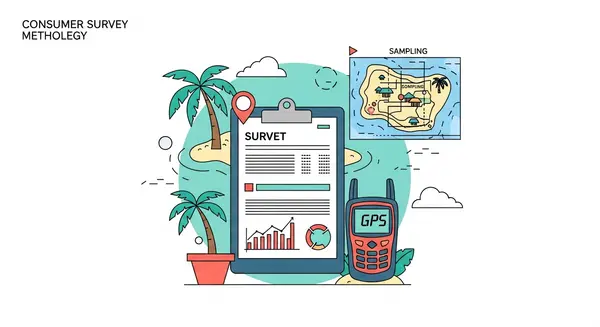
Designing a statistically sound consumer survey for a market of 50,000 people is genuinely different from designing one for a market of 5 million. The finite population correction changes sample size requirements. The geographic coverage challenge shifts from stratification across regions to near-census coverage of a small island. The sampling frame is built from sources that do not exist as standard databases. And the data quality protocols must account for the social dynamics of small communities where interviewers and respondents often inhabit overlapping social networks. This guide covers the methodological decisions that matter most in Caribbean small island survey research.
Small Island Survey Methodology: Key Parameters
n=385
Standard sample for infinite population at 5% margin of error, 95% confidence; applies directly to Caribbean markets above approximately 100,000 adults
FPC
Finite Population Correction must be applied for markets under 100,000; can reduce required n by up to 40% in very small markets while maintaining equivalent precision
10%
HRG minimum back-check rate: 1 in every 10 completed interviews verified by a second supervisor contact to detect fabrication and comprehension errors
25-35 min
Target interview duration for face-to-face Caribbean consumer surveys; beyond 40 minutes, item non-response and fatigue effects degrade data quality measurably
GPS
GPS-verified interview location logging is HRG standard practice in all Caribbean fieldwork to verify geographic coverage quotas and detect urban concentration bias
48 hrs
Maximum data transmission lag from field to data processing; same-day submission via mobile data entry apps is the HRG standard where connectivity permits
Understanding the Finite Population Context
The statistical theory of survey sampling was developed primarily in the context of large populations where the number of potential respondents is so large relative to the sample that each interview adds negligible new information about the population distribution. This infinite population assumption does not hold for island markets with adult populations under 100,000, and it breaks down completely for markets under 20,000. Understanding this matters not just for sample size calculations but for the entire logic of how you achieve representative coverage.
In a large market, a random sample of 400 people from a population of 5 million gives you 0.008% of the population, and the statistical theory assures you this is enough to estimate population parameters within defined confidence bounds. In a market of 10,000 adults, a sample of 150 is 1.5% of the population, and achieving this genuinely random sample requires covering virtually every geographic subdivision of the island and recruiting across all demographic strata with a thoroughness that is logistically much more demanding than the pure statistical arithmetic suggests.
Building the Sampling Frame
The sampling frame is the list or map from which sample units are drawn. In Caribbean small island markets, there is no single ideal sampling frame: telephone directories are outdated, online panels do not exist at scale, and household registers are not publicly available in most markets. HRG uses a multi-source approach anchored in census enumeration district maps. These ED maps, produced by national statistical offices in conjunction with population and housing censuses, divide each island into numbered geographic units with population counts and physical boundary descriptions.
The area probability sampling approach derived from these maps works as follows. First, all EDs in the country are listed with their population counts. Second, EDs are selected with probability proportional to population size using systematic random selection. Third, within each selected ED, a local field supervisor walks the enumeration area and produces a household listing. Fourth, a fixed number of households is randomly selected from this listing using a random starting point and fixed interval. Fifth, within each selected household, an eligible adult is selected using the Kish grid or next-birthday method to ensure random respondent selection at household level.
Free Caribbean Market Assessment
Discover which research methodology best fits your Caribbean market entry strategy.
Questionnaire Design for Island Populations
Questionnaire design for Caribbean small island face-to-face surveys must account for a literacy and educational attainment distribution that differs from metropolitan research contexts. Literacy rates vary from over 95% in Barbados and Trinidad to below 50% in parts of rural Haiti (World Bank literacy data, 2023). Even in high-literacy markets, respondents with primary school education as their highest qualification have difficulty with complex multi-attribute scales, conditional branching logic expressed in question text, and abstract concepts presented without concrete referencing.
HRG's questionnaire design standards for Caribbean small island surveys include: maximum scale length of 5 points for general consumer samples (7-point and 10-point scales can be used with higher-education segments); all product and brand names tested in cognitive pilot interviews to verify local recognition and pronunciation; skip patterns managed by the interviewer rather than built into question text; and response options presented on show cards for face-to-face interviews wherever the response set exceeds 3 items. Every questionnaire undergoes a cognitive pre-test with 10 to 15 members of the target population before main fieldwork begins, with a debrief designed to surface comprehension problems and culturally inappropriate phrasings.
Fieldwork Logistics and Data Quality
| Data Quality Risk | Caribbean Prevalence | HRG Mitigation |
|---|---|---|
| Urban concentration bias | High: capital cities easier to work in | GPS verification + rural coverage quotas with penalty for shortfall |
| Acquaintance interviewing | Medium-high: small community social overlap | Interviewers assigned outside their home community by default |
| Interview fabrication | Medium: where back-check capacity is low | 10% back-check rate, GPS logging, CAPI audit trails |
| Scale comprehension errors | Medium: variable literacy, complex scales | Max 5-point scales, show cards, cognitive pre-test |
Logistics specific to island fieldwork include boat or ferry transportation for multi-island nations such as St. Kitts and Nevis, Antigua and Barbuda, or Trinidad and Tobago. Field supervisors in these markets must factor in ferry schedules and weather conditions that can cancel sailings when planning geographic coverage. HRG builds at least 2 extra travel days into any multi-island fieldwork plan as contingency for ferry or inter-island flight disruption. For very small outer islands with infrequent transport connections, we schedule fieldwork to align with regular ferry days and complete all interviews in a single visit to avoid repeat travel costs.
Caribbean Market Intelligence
Monthly research insights, consumer trends data, and industry analysis from 30+ Caribbean and Latin American markets.
Small Island Research Requires Specialist Protocols
HRG has developed small island survey methodology through years of fieldwork in markets ranging from 5,000 to 500,000 people across the Caribbean. We apply statistically sound, logistically realistic sampling protocols that produce data quality comparable to research in much larger markets. Contact us to discuss your small island research project.
Discuss Your ProjectRelated Research
How to Do Market Research in the Caribbean
The complete 7-step Caribbean research framework that contextualises the small island survey protocols covered here.
Qualitative Research Methods in the Caribbean
When quantitative surveys are insufficient and qualitative methods are needed for Caribbean consumer insight.
Trade Audit Methodology in the Caribbean
How retail audit methodology adapts to the mixed formal/informal trade channels of small island markets.
St. Lucia Consumer Trends 2025
An example small island market where the methodologies described in this guide are applied in practice.
Antigua and Barbuda Consumer Trends 2025
A two-island nation where ferry-based multi-island fieldwork logistics apply in practice.
Market Sizing Methodology for Emerging Markets
How survey data from small island markets feeds into bottom-up market sizing models for investment and entry decisions.
consumer survey methodology small island Research Report
Get our comprehensive consumer survey methodology small island data pack with market analysis, competitive insights, and growth forecasts for strategic planning.