Dominica Ecotourism: Nature Island Guide, Eco-Lodges, Wildlife and Market Data 2025
Dominica is the Caribbean's definitive ecotourism destination. With 365 rivers, 9 volcanic centres, year-round whale watching, and a deliberate no-mass-tourism policy, the Nature Island generates $200 to $350 in daily visitor spend with 65 to 85 percent retained locally. This guide covers the destination, the eco-lodge market, key conservation examples, and 2025 visitor trends.
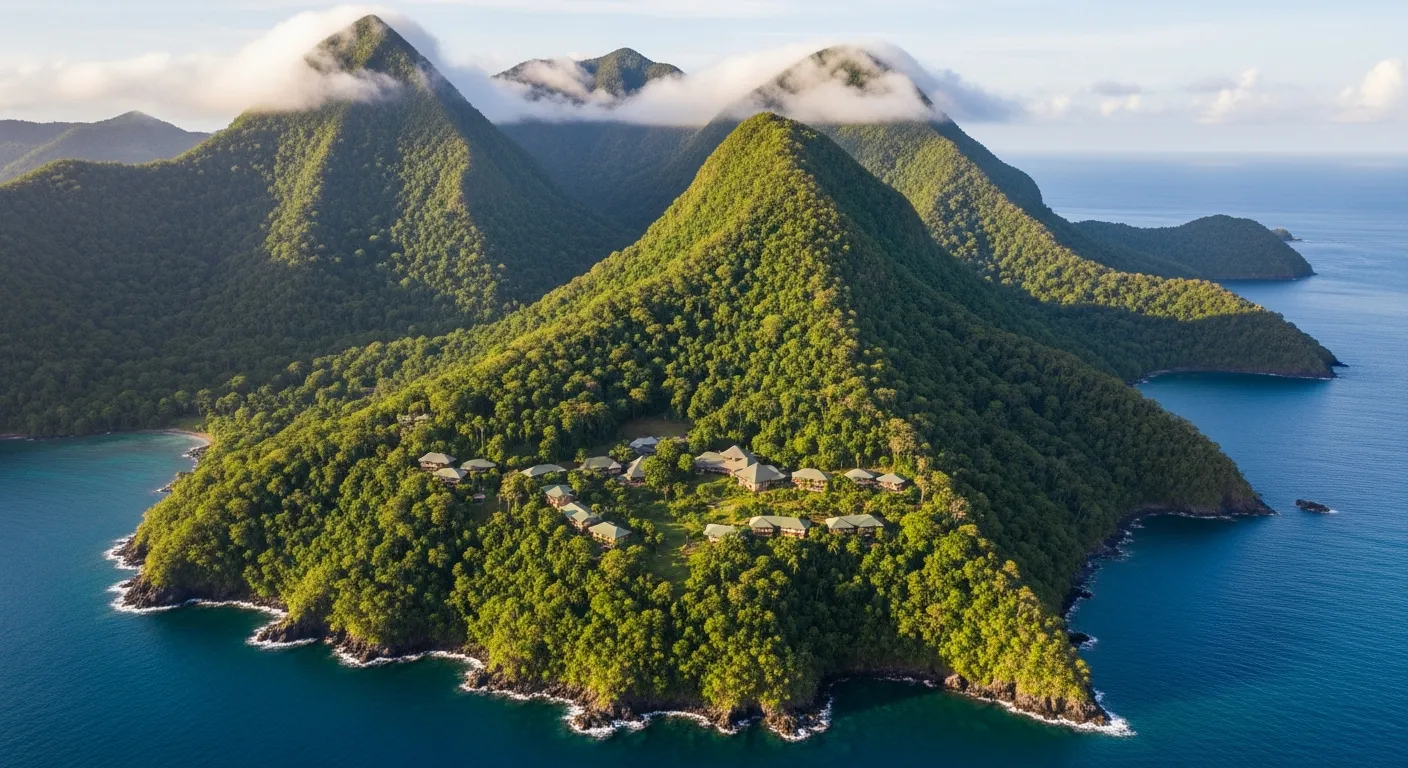
Dominica at a Glance: The Nature Island
Dominica made a strategic policy choice decades ago that distinguishes it from virtually every other Caribbean island: it chose not to build large-scale beach resorts or cruise infrastructure, instead positioning itself as a destination for travelers who come specifically to engage with nature. This decision, which seemed commercially limiting at the time, has produced a tourism model that generates higher per-visitor yield, stronger local economic benefit, and greater destination resilience than mass-market alternatives. After Hurricane Maria devastated the island in 2017, Dominica rebuilt with an explicit "climate-resilient nation" framework, reinforcing its differentiated positioning.
Top Ecotourism Experiences in Dominica
Boiling Lake and the Valley of Desolation
The Boiling Lake hike is Dominica's signature ecotourism experience and one of the most extraordinary natural phenomena in the Western Hemisphere. The lake, 200 feet across, sits in a volcanic crater and maintains temperatures of 82 to 91 degrees Celsius at its edges, with the centre in a state of perpetual boiling from geothermal activity below. The 6 to 7 hour return hike passes through the Valley of Desolation, a sulfurous moonscape of fumaroles, hot springs, and bubbling mud pools that makes Dominica's volcanic geology immediately legible. Guided tours are mandatory and cost $40 to $80 per person; a healthy industry of qualified mountain guides operates from Laudat village.
Whale Watching: The Caribbean's Premier Cetacean Destination
Dominica's submarine canyon drops to more than 3,000 meters within two miles of the coastline, creating the deep-water feeding environment that attracts resident sperm whale pods year-round. The Dominica Sperm Whale Project, operating since 2005, has identified and named over 30 individual whales. Operators charge $80 to $120 per person for morning or afternoon whale watching trips departing from Roseau or Portsmouth. Humpback whales are present from January through April; sperm whales are resident all year.
Champagne Reef: Geothermal Marine Experience
Champagne Reef, named for the continuous stream of tiny geothermal bubbles rising through the seafloor, is one of the most unique diving and snorkelling sites in the Caribbean. The warm, effervescent water creates a sensory experience unlike any conventional reef dive, and the marine biodiversity is exceptional: seahorses, flying gurnards, frogfish, and dense schools of chromis inhabit the geothermally warmed shallows. Entry fees support the Dominica Maritime Division's reef conservation program. Scotts Head Pinnacle, at the island's southern tip where the Atlantic meets the Caribbean, offers wall diving to 45 meters with large pelagic species.
Morne Trois Pitons National Park (UNESCO World Heritage)
Morne Trois Pitons, Dominica's UNESCO World Heritage Site since 1997, is the only natural World Heritage property in the Eastern Caribbean. The 6,857-hectare park encompasses the Boiling Lake, Freshwater Lake, Boeri Lake, the Valley of Desolation, and primary tropical rainforest. The park's trail network includes routes for day hikers and multi-day expeditions. The Waitukubuli National Trail connects the park to Dominica's 115-mile end-to-end hiking route, the longest in the Caribbean, which threads through 14 trail segments from the island's south to its northern tip.
Eco-Lodge Market in Dominica
Dominica's accommodation market is defined by small, owner-operated eco-properties. There are no all-inclusive mega-resorts; the largest properties on the island have fewer than 100 keys. This structure is intentional and protected by government policy.
Jungle Bay
Post-Maria green rebuild benchmark40 eco-cottages on a 55-acre working organic farm. Rebuilt post-Hurricane Maria using local timber and LEED-equivalent principles. Rates from $350 per night including organic meals. Packages emphasize hiking, yoga, and farm-to-table.
Secret Bay
Ultra-luxury eco positioningUltra-luxury eco-villas perched on a cliffside above a secluded bay. 6 villa units at $700 to $2,500 per night. Consistently ranked among the top Caribbean resorts by Conde Nast and Travel + Leisure.
Papillote Wilderness Retreat
Pioneer of Caribbean eco-lodgingA 40-year-old botanical garden property with natural geothermal pools. Family-operated since 1969. One of the original Caribbean eco-lodges. Rates from $150 per night. Restaurant serves garden-grown produce.
Rosalie Bay
Turtle conservation integrationAll-inclusive eco-resort on the wild Atlantic coast. Partners with the Dominica Sea Turtle Conservation Organization for guest participation in nesting monitoring. 28 keys. Rates from $500 per night.
Economic Model: Why Dominica Ecotourism Outperforms Mass Tourism
| Metric | Dominica Ecotourism | Mass All-Inclusive Tourism |
|---|---|---|
| Average daily spend | $200–$350 | $80–$120 |
| Local economic retention | 65–85% | 20–40% |
| Employment type | Guides, farms, local transport | Resort staff (often imported management) |
| Infrastructure stress | Low (trails, small lodges) | High (beaches, water, waste) |
| Length of stay | 5–10 nights | 3–5 nights |
| Repeat visitation | High (45–60%) | Moderate (25–35%) |
| Brand positioning value | Premium, differentiated | Commodity, price-competitive |
Dominica After Hurricane Maria: The Resilient Rebuild
Hurricane Maria made direct landfall on Dominica on September 18, 2017 as a Category 5 storm, destroying 90 percent of the island's buildings and infrastructure. The damage was catastrophic but the government's response became a global case study in post-disaster resilience planning. Prime Minister Roosevelt Skerrit committed to rebuilding Dominica as the world's first climate-resilient nation, a goal that explicitly incorporated ecotourism as a core pillar. Reconstruction standards were elevated to withstand Category 5 winds. Solar and geothermal energy investment expanded. The Waitukubuli Trail, damaged in the storm, was rebuilt with improved trailhead infrastructure and expanded guide training programs.
By 2022, visitor arrivals had recovered to pre-Maria levels, and the rebuild period attracted a cohort of international investors specifically drawn to Dominica's Citizenship by Investment (CBI) program, which funded a portion of the reconstruction. Several eco-properties rebuilt with CBI capital emerged as improved versions of their pre-Maria iterations, including Jungle Bay. The net effect of Maria on Dominica's tourism positioning was, paradoxically, positive: the island's identity as a place that takes environmental stewardship seriously was reinforced by the seriousness of its response.
Dominica in the Broader Caribbean Ecotourism Context
Dominica is the most advanced example of Caribbean ecotourism positioning but not the only one. Belize, Bonaire, and St Lucia have each developed distinct sustainable tourism offerings that together define the regional ecotourism cluster. For the broader Caribbean ecotourism market data including growth rates, market sizing, and cross-destination comparison, see our Caribbean Ecotourism Growth 2025 analysis.
Caribbean ecotourism as a segment is growing at 12 to 15 percent annually, significantly outpacing the 5 to 7 percent growth of conventional mass tourism. Dominica consistently features in top-tier travel media as a paradigm case, and the island's story is regularly cited by destination marketing organisations across the region as a model for premium positioning without mass-market infrastructure investment.
Frequently Asked Questions
Why is Dominica called the Nature Island of the Caribbean?
Dominica earned the title "Nature Island of the Caribbean" through a combination of exceptional natural geography and deliberate government policy to position the island as a premium ecotourism destination rather than competing with mass-market beach tourism. Dominica has 365 rivers (one for every day of the year), 9 active volcanic centres, the second-largest hot spring in the world (Boiling Lake), 290 recorded bird species including the rare Sisserou parrot (found nowhere else on Earth), and 60 percent primary rainforest cover. The island made a strategic decision in the 1980s not to build large-scale beach resort infrastructure and instead invest in trail systems, marine parks, and ecotourism certification.
What are the top ecotourism experiences in Dominica?
The top ecotourism experiences in Dominica include: Boiling Lake hike (6 to 7 hour round trip through the Valley of Desolation to the second-largest boiling lake in the world), Champagne Reef diving (geothermal vents create a natural champagne bubble effect in shallow water), whale watching (Dominica has 80 percent year-round humpback and sperm whale presence, the highest concentration in the Eastern Caribbean), Titou Gorge swimming (narrow volcanic gorge featured in Pirates of the Caribbean filming), the Waitukubuli National Trail (115-mile end-to-end island trail, the longest in the Caribbean), and the Morne Trois Pitons National Park (UNESCO World Heritage Site).
How does Dominica ecotourism compare economically to mass tourism?
Dominica ecotourism generates substantially higher local economic value per visitor than equivalent mass tourism. The average ecotourist in Dominica spends $200 to $350 per day versus $80 to $120 for typical cruise day visitors. More importantly, eco-tourism retains 65 to 85 percent of visitor expenditures within the local economy through locally owned eco-lodges, guides, farm-to-table food systems, and transportation. Mass all-inclusive tourism typically retains only 20 to 40 percent locally. Dominica deliberately limits cruise ship arrivals to protect the premium positioning of its land-based ecotourism product.
What eco-lodges operate in Dominica?
Key eco-lodges and sustainable properties in Dominica include: Jungle Bay (40 eco-cottages on a working organic farm, rebuilt post-Hurricane Maria with LEED-equivalent construction, packages include guided hikes and yoga), Secret Bay (ultra-luxury eco-villa property on a cliff above a secluded bay, recognized by Condé Nast and Travel + Leisure as a top Caribbean resort), Papillote Wilderness Retreat (40-year-old botanical garden property with natural thermal pools, operated by the same family since 1969), and Rosalie Bay (an all-inclusive eco-resort on the windward coast supporting sea turtle conservation). Most Dominica eco-properties are owner-operated with 10 to 50 keys, consistent with the island's small-scale philosophy.
What is the whale watching market in Dominica?
Dominica is the premier whale watching destination in the Eastern Caribbean, with sperm whale (Physeter macrocephalus) and humpback whale populations present year-round at rates exceeding 80 percent sighting probability. Dominica's submarine canyon system, one of the deepest in the Caribbean at 1,000 to 3,000 meters, provides the deep water feeding environment that attracts resident sperm whale pods. The Dominica Sperm Whale Project has been tracking individual whale families since 2005, making Dominica one of the most scientifically significant cetacean research sites in the Atlantic. Whale watching operators typically charge $80 to $120 per person for a 3 to 4 hour trip, with a local economic multiplier from guide training, boat maintenance, and associated lodge stays.
Ecotourism Market Research for the Caribbean
Hope Research Group conducts tourism market research across the Caribbean including visitor profiling, eco-lodge feasibility studies, conservation tourism impact assessment, and destination positioning analysis. We work with tourism boards, developers, and NGOs.
Discuss a Research ProjectRelated Research
Free Caribbean Market Assessment
Discover which research methodology best fits your Caribbean market entry strategy.