South Caribbean Market Research: Trinidad and Tobago, Guyana, Suriname and Barbados
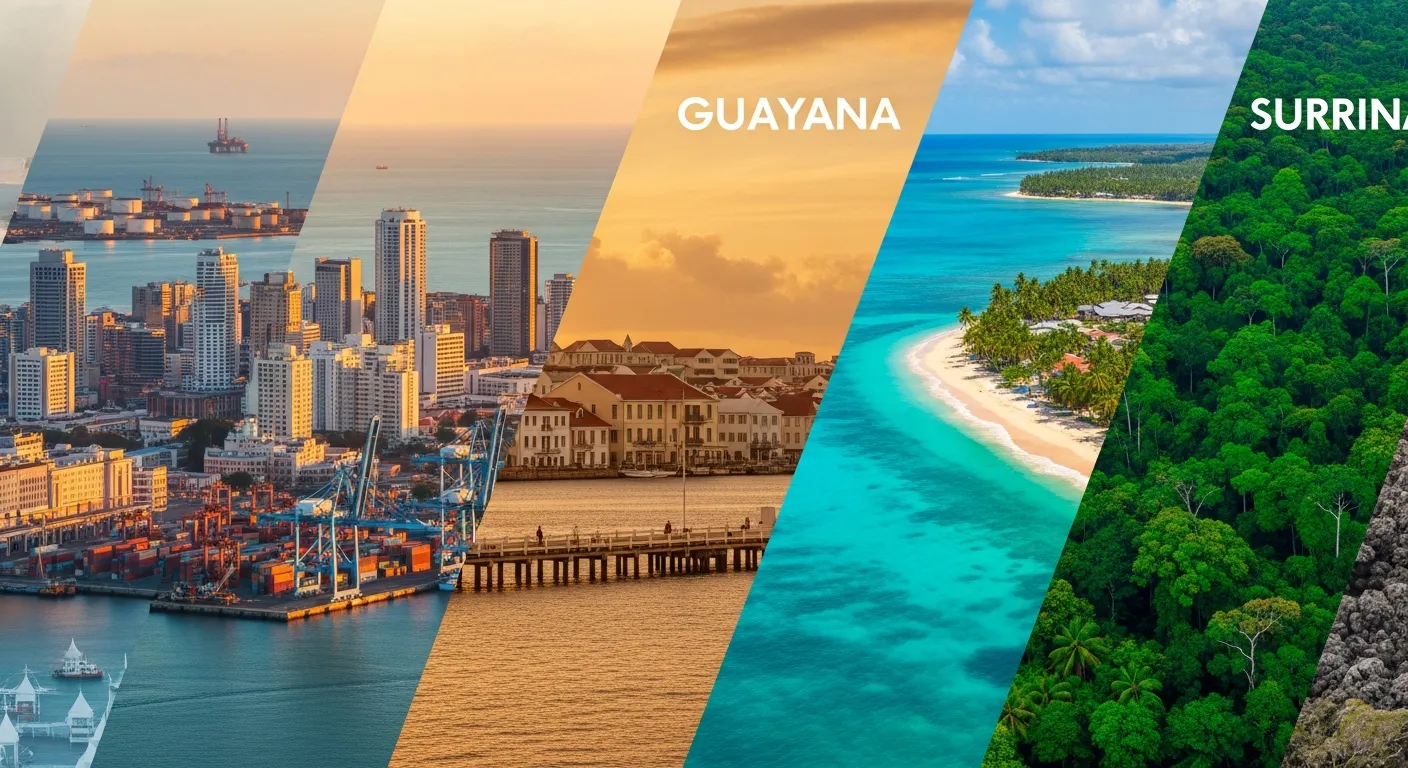
The South Caribbean hosts the Caribbean's most energy-intensive economies and some of its highest per capita incomes. Guyana's 34.3% GDP growth in 2024 is transforming a former agricultural economy into one of the world's fastest-growing oil producers. Trinidad and Tobago anchors the region as the Caribbean's industrial and FMCG production hub. Suriname's emerging market offers frontier consumer research opportunities. Barbados is the subregion's premium tourism and financial services play. HRG maintains active field research capacity in all four markets.
South Caribbean Region: Key Statistics
34.3%
Guyana GDP growth estimate in 2024, driven by offshore oil production from ExxonMobil's Stabroek Block (ECLAC, 2024)
45%
Energy sector share of Trinidad and Tobago's GDP, underpinning the Caribbean's largest industrial economy (T&T Ministry of Finance, 2024)
$36K
Trinidad and Tobago GDP per capita PPP in USD 2024, among the highest in the Caribbean (World Bank / Wikipedia, 2024)
3.9%
Barbados GDP growth in 2024, driven by premium tourism and financial services reform (ECLAC / Savory and Partners, 2024)
2.8%
Suriname GDP growth in 2024, with offshore oil discoveries positioning the country for future growth acceleration (ECLAC, 2024)
4
CARICOM member states in the South Caribbean, all integrated through the Caribbean Single Market and Economy framework
Trinidad and Tobago: The Caribbean's Industrial Hub
Trinidad and Tobago is the most structurally distinct economy in the Caribbean. Where most island economies depend on tourism, T&T is built on hydrocarbons: LNG, petrochemicals, ammonia, methanol, and steel. The energy sector accounts for approximately 45% of GDP and the vast majority of government revenues and foreign exchange. The country holds approximately 0.25% of the world's natural gas reserves and is the Caribbean's leading exporter of liquefied natural gas, with a sovereign wealth fund equal to approximately one and a half times the national budget providing a buffer against energy price volatility (Moody's Analytics / Wikipedia, 2024).
This industrial foundation has produced a large, sustained middle class with purchasing power patterns more aligned with Latin American upper-middle income markets than with smaller Caribbean island economies. T&T's FMCG manufacturing sector produces regionally distributed brands across food and beverage, personal care, and household products, making it the most important node in the intra-Caribbean consumer goods supply chain. GDP growth of 2.4% in 2024 was modest by regional standards but reflects an economy with fundamentally different structural dynamics from its tourism-dependent neighbours.
T&T's roughly equal ethnic split between Afro-Trinidadian and Indo-Trinidadian communities creates a culturally complex research environment. Media consumption, food preferences, religious observance, festival participation, and brand loyalty patterns differ measurably between communities and between the two islands of Trinidad and Tobago. Representative national research samples require ethnically stratified quota controls, and focus group protocols must account for community sensitivities when presenting comparative findings.
Guyana: The Caribbean's Fastest-Growing Consumer Market
Guyana's economic transformation since commercial oil production began in 2019 has been extraordinary. GDP growth of an estimated 34.3% in 2024 according to ECLAC projections, building on 30%+ growth in 2022 and 2023, reflects the continued ramp-up of production from ExxonMobil's Stabroek Block with partners Hess and CNOOC. The IDB confirmed Guyana's growth exceeded 30% in 2024. Oil revenues are flowing into government infrastructure spending, public sector salary increases, and private sector activity concentrated in Georgetown and the coastal strip where approximately 90% of Guyana's 800,000 people live.
The market research implications are substantial. Baseline consumer data from 2020 or earlier is now largely obsolete as purchasing power, retail channel development, brand availability, and consumer aspirations have all shifted dramatically. New retail formats are entering Georgetown, including modern supermarkets and international restaurant chains, displacing traditional market trader formats. Income inequality has increased as oil wages have pulled ahead of agricultural and informal sector incomes, creating a bifurcated consumer market that research designs must navigate with careful segmentation. New baseline studies are in high demand from consumer goods companies, financial services providers, and retailers entering the market.
Guyana also holds the distinction of being identified in a 2024 Nature Food study as the world's only nation among 186 assessed to achieve full domestic food self-sufficiency, exporting 425,490 metric tonnes of rice to 30 countries valued at USD 254 million in 2024 (Guyana Ministry of Agriculture, 2024). This agricultural foundation co-exists with the oil boom, creating a dual economy that research must navigate carefully when assessing consumer food preferences, retail purchasing behaviour, and agricultural supply chain dynamics.
Barbados: Premium Market and Financial Services Hub
Barbados consistently ranks among the Caribbean's highest per capita income economies, with GDP per capita of approximately USD 20,184 in 2022 (IMF World Economic Outlook Database, October 2022) and GDP growth of 3.9% in 2024 driven by tourism recovery and financial services reform. As a FATF and OECD-compliant international financial services jurisdiction alongside the Bahamas, Barbados attracts legitimate wealth management and fund administration business, and the digital nomad Welcome Stamp programme launched in 2020 has added a distinct international remote-worker consumer segment to an already sophisticated consumer market. The shift toward luxury and experiential travel has elevated average visitor spending, and Barbados's Bridgetown Warrens commercial corridor has expanded its premium retail and restaurant offering to serve both resident and visitor demand.
For premium product and brand positioning research, Barbados serves as the South Caribbean's most revealing reference market. The product mix sustainable on Barbadian supermarket shelves, the brand preferences of the Barbadian professional middle class, and the consumer values around quality, sustainability, and premium positioning give suppliers actionable intelligence about what the aspirational Caribbean consumer rewards with loyalty and repeat purchase. The small national population of approximately 290,000 requires larger relative sample sizes for nationally representative studies, but Barbadian respondents consistently deliver high response quality and engagement in primary research instruments.
Suriname: The South American Caribbean Frontier
Suriname is the South Caribbean's most linguistically distinct market and its closest analogue to Guyana in terms of economic trajectory. Dutch is the official language, shared with the Dutch Caribbean territories of Aruba, Curacao, and the BES islands, but Sranan Tongo, an English-based creole language, serves as the primary spoken lingua franca across Suriname's ethnically diverse population. Large communities also speak Hindi, Javanese, Saramaccan, and other languages reflecting a colonial-era population composition of South Asian indentured workers, Javanese labourers, Maroon communities of escaped enslaved Africans, and indigenous Amerindian peoples.
GDP growth of 2.8% in 2024 represents steady but below-potential performance. TotalEnergies' offshore oil discoveries at the Sapakara and Kwaskwasi blocks are moving through development approvals, with commercial production potentially beginning in the late 2020s. If realised at projected scale, Suriname's oil revenue trajectory could parallel Guyana's, making early-mover market intelligence investment particularly valuable for companies seeking to establish brand and distribution positions before a potential boom-driven consumption acceleration. HRG conducts Suriname research through our Dutch-language and Sranan Tongo-capable partner network in Paramaribo, the country's capital and commercial centre where approximately 60% of the population is concentrated.
Research Methodology Considerations
Each South Caribbean market has distinct research infrastructure and methodology requirements. In T&T, the dual-island structure demands explicit sampling controls, and the ethnic community composition requires quota management to ensure representative coverage. Face-to-face interviewing is the standard approach for general consumer studies; telephone and online supplements are viable for professional and upper-income urban segments. Retail audit across T&T's structured modern trade requires engagement with the handful of supermarket chains that dominate distribution, supplemented by traditional trade channel coverage in mini-marts, parlours, and market stalls.
In Guyana, the coastal concentration of population simplifies geographic coverage compared to the vast and sparsely populated interior, but within Georgetown's rapidly growing urban area, neighbourhoods have diverged sharply in socioeconomic character since 2020, making neighbourhood-level quota controls important for income-stratified studies. Barbados supports a full range of quantitative and qualitative research formats with short fieldwork timelines given the island's compact geography. Suriname requires language planning upfront: Dutch instruments cover the educated urban population but Sranan Tongo moderation is essential for qualitative research and face-to-face surveys targeting representative general population samples.
Country Comparison
| Country | Population | GDP Growth 2024 | Currency | Key Economy | Language |
|---|---|---|---|---|---|
| Trinidad and Tobago | ~1.51M | 2.4% | TT dollar (USD peg) | LNG, petrochemicals, FMCG manufacturing | English |
| Guyana | ~800,000 | 34.3% (est.) | Guyanese dollar (GYD) | Oil production, rice, gold, timber | English |
| Suriname | ~620,000 | 2.8% | Surinamese dollar (SRD) | Gold, oil (emerging), agriculture | Dutch |
| Barbados | ~290,000 | 3.9% | Barbados dollar (BBD, USD peg) | Premium tourism, financial services | English |
Research Methodologies for the South Caribbean
Each of the four South Caribbean markets requires a distinct research approach reflecting its economic structure, demographic composition, and consumer research maturity. In Trinidad and Tobago, face-to-face interviewing remains the gold standard for representative national samples, with online and telephone supplementation appropriate for higher-income professional segments. The two-island structure requires deliberate sampling across both Trinidad and Tobago, as Tobago's smaller, more tourism-dependent economy and predominantly Afro-Tobagonian population create meaningfully different consumer profiles from the Port of Spain metropolitan area or the industrial south.
In Guyana, rapid economic change means research designs must be carefully calibrated to the current market rather than historical precedent. Georgetown and New Amsterdam (the second city in the oil-producing Berbice region) require separate sampling strategies. Rural and Amerindian community research in the interior requires specialised logistics and local intermediary relationships that go beyond standard fieldwork protocols. Mobile penetration is growing rapidly in Georgetown but remains limited in interior and riverine communities, making hybrid digital-face-to-face approaches appropriate only for urban consumer segments.
Barbados is the South Caribbean's most research-mature market, with a population familiar with consumer surveys and comfortable in structured interview formats. Online surveys achieve usable response rates among Barbadian adults under 55, making web-based data collection viable for studies targeting working-age consumers. The density of the island and the concentration of consumer activity in the Bridgetown Warrens corridor enables retail audit fieldwork to be completed efficiently with small teams. Suriname requires Dutch-language instruments for formal administration and Sranan Tongo moderation for qualitative work targeting representative community samples across the country's diverse ethnic groups.
Commercial Research Opportunities in the South Caribbean
The South Caribbean's economic dynamism creates specific high-value research opportunities. In Guyana, the demand for new-baseline consumer studies is acute: retailers, financial services providers, FMCG brands, and telecoms companies entering or expanding in the market all need current data that simply does not exist in standard international research databases. Feasibility studies assessing the commercial viability of new retail formats, restaurant concepts, financial products, and service businesses in Georgetown are among the most commercially valuable research products HRG delivers in this market.
In Trinidad and Tobago, the most in-demand research types are brand equity tracking studies that monitor how consumer brands are performing across the dual Afro-Trinidadian and Indo-Trinidadian market segments, HRI operator and food service procurement research for suppliers selling into the hospitality sector, and retail distribution audits for FMCG companies assessing shelf presence and competitive positioning across the island's supermarket, minimarts, and traditional trade channels. T&T also generates significant demand for employee satisfaction and HR research given the large corporate sector associated with the energy industry.
Barbados and Suriname generate more specialised research demand. In Barbados, financial services market research, visitor experience research for the tourism sector, and brand positioning studies for premium consumer goods are the primary research categories. In Suriname, the emerging research agenda is driven by foreign investors and companies assessing the market as TotalEnergies' oil production timeline approaches commercial scale, making market entry feasibility studies and supply chain research the dominant request types.
HRG Field Capabilities in the South Caribbean
Hope Research Group maintains active field research operations in all four South Caribbean markets. Trinidad and Tobago is one of our highest-volume research markets, with a permanent local field coordinator team conducting consumer surveys, focus groups, retail audits, and brand tracking across both islands, with ethnically stratified sampling protocols for nationally representative studies. Our T&T team is experienced in both the Port of Spain and San Fernando metropolitan markets as well as rural and semi-urban communities, and can support fast-turnaround omnibus studies that give clients access to national consumer data cost-effectively.
Guyana is our fastest-growing active market. Our Georgetown-based field team conducts urban consumer surveys across the East Coast Demerara and East Bank Demerara corridors, New Amsterdam, and the oil services communities of Berbice, and can coordinate rural fieldwork along the coastal strip with appropriate advance planning. Barbados research benefits from a highly responsive consumer population, strong mobile penetration enabling hybrid fieldwork approaches, and a compact organised retail landscape suited to efficient retail audit methodology. Suriname fieldwork is managed through our Dutch-language and Sranan Tongo-capable partner network in Paramaribo, with full coverage of the country's multicultural consumer segments across all major ethnic communities.
South Caribbean Research Opportunities
The South Caribbean's economic dynamism creates specific high-value primary research needs that HRG is positioned to address:
- Guyana consumer baseline studies: Brand awareness, retail channel preference, and category penetration tracking for the boom-economy consumer market with quarterly update capability
- T&T cross-community brand equity: Ethnically stratified brand and advertising effectiveness research spanning Afro-Trinidadian and Indo-Trinidadian consumer segments
- T&T retail audit: Shelf presence and distribution tracking across supermarket, minimart, and traditional trade channels, island-by-island
- Barbados premium positioning: Consumer attitude and price sensitivity research for premium imported goods and financial services products
- Suriname market entry feasibility: Consumer sizing, competitive landscape, and distribution channel assessment for companies preparing for the anticipated oil-era growth acceleration
Research Snapshot: Guyana Baseline Studies
Consumer data collected in Guyana before 2022 should be treated as pre-boom baseline rather than current market intelligence. Income quartile distributions, brand awareness levels, retail channel preferences, and product category penetration rates have all shifted substantially since the oil revenue inflow accelerated. HRG recommends full baseline resets for any Guyana-focused research programme that relies on data older than 18 months, with particular attention to upper-income segment expansion in Georgetown, the growing middle-class consumer base in New Amsterdam and the Berbice oil corridor, and the persistence of traditional purchasing patterns among agricultural and rural communities whose income trajectory lags the urban boom. Multi-wave tracking is strongly recommended over one-time studies to capture the market's ongoing rapid evolution.
Research Across the South Caribbean
From Guyana's boom-economy consumer baseline studies to T&T brand tracking across Afro-Trinidadian and Indo-Trinidadian communities, HRG delivers rigorous primary research across the South Caribbean's four most commercially dynamic markets. Contact us for a project proposal.
Request a ProposalRelated Research
Suriname Consumer Trends 2025
Consumer behaviour, retail landscape, and emerging oil economy dynamics in the Dutch-speaking South Caribbean frontier market.
Caribbean Food Import Analysis
Guyana as the Caribbean's only self-sufficient food producer and T&T and Barbados as high-dependency import markets.
Caribbean Fintech and Digital Payments
Digital banking adoption in T&T's banked industrial economy, Guyana's rapidly modernising financial sector, and Barbados fintech.
Caribbean Real Estate Market Trends
Georgetown Guyana's construction boom, Barbados luxury property demand, and T&T residential market dynamics.
Caribbean Renewable Energy Market
Barbados's climate commitments and solar transition, T&T's energy diversification challenge, and Guyana's oil-versus-renewables debate.
Caribbean Insurance Market Analysis
T&T's sophisticated insurance market, Guyana's rapidly growing new insurance demand, and Barbados financial services coverage.