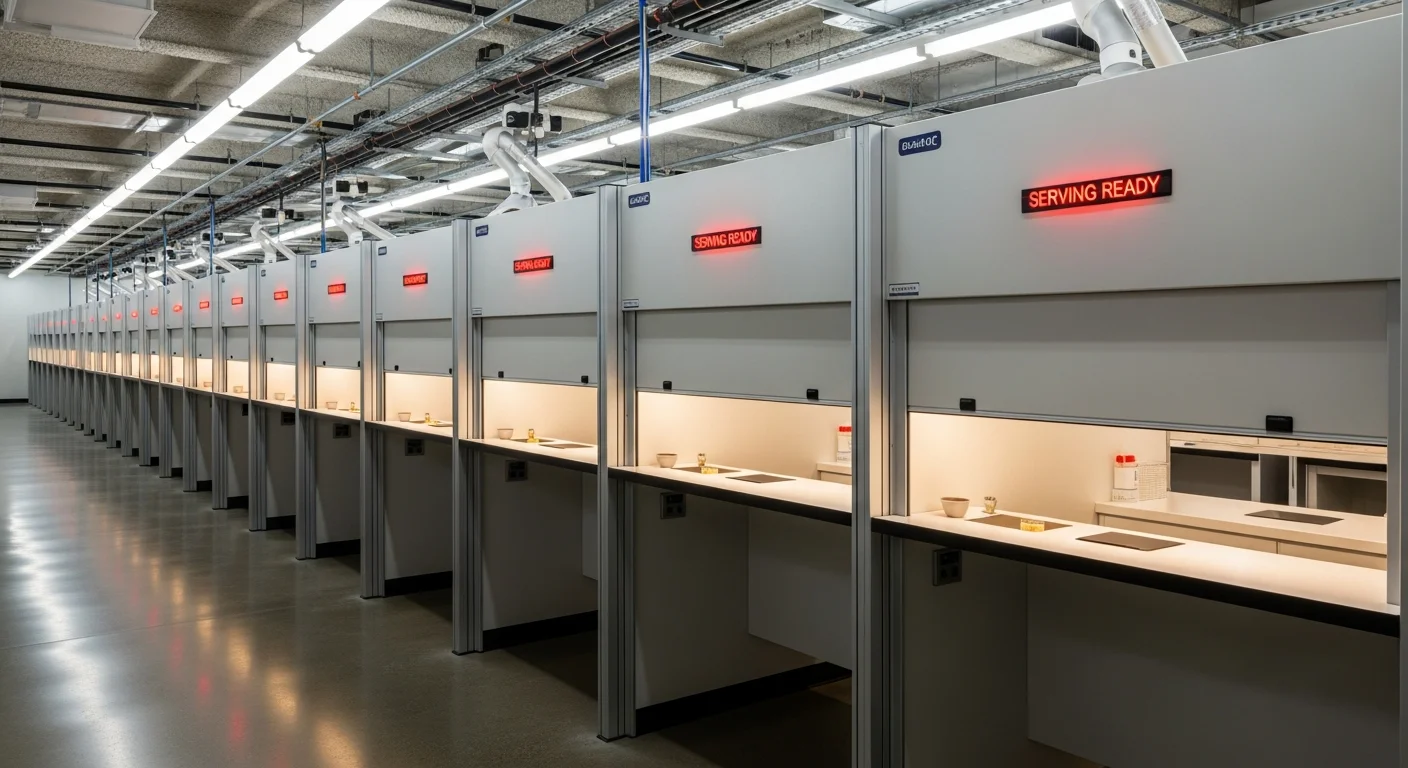
Central Location Testing in South Florida
HRG runs central location tests in hired venues in Broward County for controlled product evaluations. Individual evaluation stations, standardized serving protocols, temperature control, and bilingual English and Spanish field staff. Multi-product blind tests, reformulation validation, and competitive benchmarks.
What is central location testing?
Central location testing (CLT) is a product research method where recruited consumers come to a controlled venue to evaluate products under standardized conditions. Unlike home use tests, CLT controls temperature, portion size, serving order, and timing to isolate true sensory performance from environmental variables. HRG conducts CLT studies at hired venues in Broward County with individual evaluation stations, three-digit blind coding, bilingual field staff, and a pre-screened multicultural South Florida panel. CLT is the standard design for blind taste tests, competitive benchmarks, and reformulation validation across food, beverage, and consumer packaged goods.
CLT vs. Home Use Test: Which Do You Need?
| Use CLT When | Use HUT When |
|---|---|
| Testing multiple products in one session | Naturalistic usage over several days matters |
| Small sensory differences are critical to detect | Complex home preparation is part of the experience |
| Controlled temperature and serving are required | Repeated exposure affects the evaluation |
| Competitive benchmarking requires identical conditions | Broad geographic reach is more important than control |
| Speed and cost-efficiency of a single-site study | Shelf-stable products with consistent home conditions |
How a CLT Session Runs at HRG
Participants arrive in scheduled waves of 10 to 20, recruited at staggered times to prevent interaction in the waiting area. On arrival, a bilingual fieldworker confirms eligibility, reviews any required consent documents, and seats the participant at an individual evaluation station.
Products are served in randomized three-digit blind codes. For each product, the participant evaluates all relevant sensory dimensions on the questionnaire, then rinses with water and waits a timed interval before the next product arrives. Fieldworkers observe the session without coaching, answer only neutral procedural questions, and record any participant feedback verbatim.
After completing all product evaluations, participants complete a brief category usage and demographic questionnaire. Total session time is typically 45 to 60 minutes for a two-product test and 60 to 90 minutes for a three- to five-product test.
Quality Controls Built Into Every CLT Study
Randomized serving order and three-digit blind codes prevent position bias and brand recognition. Between-sample rest intervals reduce carry-over flavor effects. Fieldworkers are briefed on the full study protocol but do not know which products the client expects to perform better, preventing facilitation bias. Data entry is double-keyed on the day of fieldwork, and any incomplete questionnaires are flagged for review before inclusion in the dataset.
Temperature-sensitive products are stored in calibrated cold storage at the facility until the moment of serving. Hot products are maintained in warming equipment. Serving utensils, cups, and plates are standardized per product and not reused between participants.
Related Services
Frequently Asked Questions
What is central location testing (CLT)?+
Central location testing is a product evaluation method in which recruited consumers come to a controlled facility to taste, smell, or evaluate products under standardized conditions. Unlike home use tests (HUT), where products are taken home, CLT controls the serving environment: temperature, portion size, serving order, timing between samples, and evaluator neutrality. This standardization produces more reliable comparisons between products, particularly when small sensory differences matter. CLT is the standard method for blind taste tests, competitive benchmarking studies, and product reformulation validation.
When should I use CLT instead of a home use test?+
CLT is preferable when you need to control serving conditions, when you are testing multiple products in a single session, when bias from home preparation or storage would distort results, or when you need respondents to evaluate products immediately after serving. Home use tests are better when naturalistic usage over multiple days matters, when the product requires prolonged exposure (for example, a skincare product or a meal kit), or when recruiting consumers to a facility is not feasible for your target segment. For most competitive benchmarking and reformulation studies, CLT is the correct design.
How many evaluation stations can HRG set up in a Broward CLT session?+
HRG sets up simultaneous individual testing stations for each session at hired venues in Broward County. Each station is isolated to prevent respondents from seeing or influencing each other's evaluations. For large-scale studies that need high simultaneous throughput, HRG runs sequential waves within a day, across multiple days, or across multiple venues in Miami-Dade or Palm Beach for multi-site designs.
How is a CLT session structured from start to finish?+
Participants arrive in scheduled waves. On arrival, they complete a brief eligibility confirmation and any required consent forms. They are seated at individual evaluation stations and given standardized instructions by a bilingual fieldworker. Products are served in randomized order using three-digit blind codes. Between samples, participants rinse with water and observe a timed rest interval of 60 to 90 seconds. After evaluating all products, participants complete a demographic questionnaire and are thanked and debriefed. Each wave typically takes 45 to 75 minutes depending on the number of products and questionnaire length.
What products are not suitable for CLT?+
Products that require prolonged use to evaluate, such as skincare, hair care, or laundry detergents, are not suitable for CLT. Products requiring complex home preparation that cannot be replicated in a facility may also be better suited to a home use test. Products with temperature or freshness requirements that cannot be maintained during transportation from the client to the facility require additional logistics planning but are generally manageable for CLT with appropriate cold-chain arrangements.
Can HRG conduct CLT studies in Spanish or Haitian Creole?+
Yes. All fieldwork at hired venues in Broward County is conducted by bilingual English and Spanish field staff as standard. For studies targeting the Haitian-American community in Broward and northern Miami-Dade, Haitian Creole-speaking fieldworkers are available. Questionnaires are prepared and administered in the respondent's preferred language. For multi-lingual studies, sessions are typically wave-segmented by language group to avoid inter-group contamination.
Free Caribbean Market Assessment
Discover which research methodology best fits your Caribbean market entry strategy.