Dominican Republic Consumer Trends 2026: What 11M Shoppers Want
The Dominican Republic entered 2026 as the Caribbean's largest economy by GDP and its most consistent growth performer over the past decade. With 5.5% projected GDP growth, $10.8 billion in annual remittances, a rapidly expanding middle class, and 68% smartphone penetration, the DR presents a consumer market that is evolving faster than most Caribbean research strategies have accounted for.
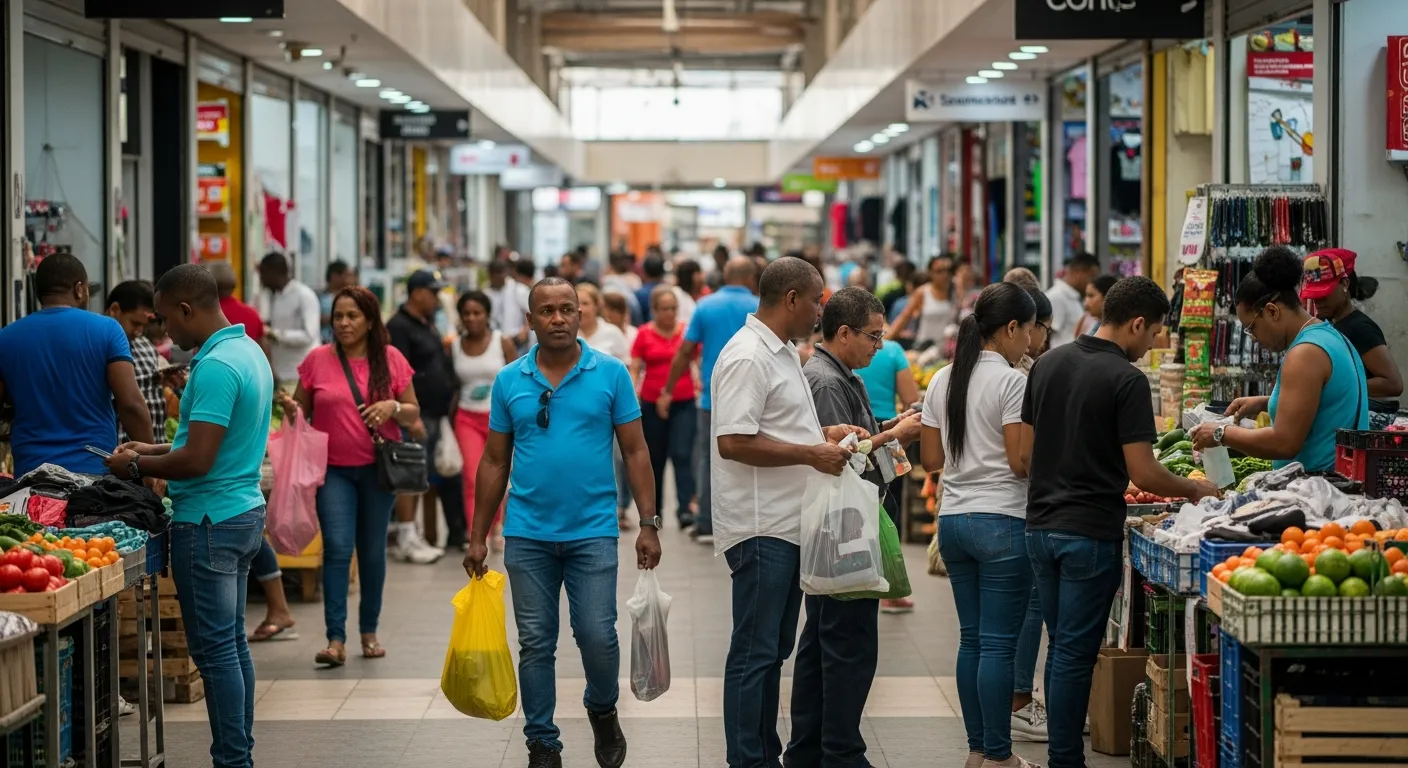
Dominican Republic 2026: Key Economic Indicators
The Dominican Economy in 2026: Structural Strengths and Vulnerabilities
The Dominican Republic's 5.5% GDP growth projection for 2026 (IMF World Economic Outlook, 2025) reflects continued structural strengths: a diversified export base anchored by tourism and free trade zone manufacturing, a relatively stable monetary policy, and increasing private investment in infrastructure and real estate. The growth rate is among the highest in the Caribbean and comfortably above the Latin American average of approximately 2.8% for the same period.
The primary vulnerability is fiscal: public debt has increased to approximately 52% of GDP (IMF, 2025), and US Federal Reserve interest rate policy directly affects the cost of Dominican government borrowing. A sustained high-interest environment in the US translates to higher borrowing costs and tighter fiscal space for Dominican social spending. For consumer goods brands, the key signal is that GDP growth does not automatically translate to consumer spending growth if real wages and informal sector income are pressured by fiscal adjustment.
Remittances as a Consumer Demand Driver
Remittances are the Dominican Republic's most stable and strategically important consumer demand signal. At $10.8 billion in 2025, remittances represent approximately 8.5% of GDP and reach roughly 1 in 3 Dominican households. Unlike GDP growth, which affects income broadly but unevenly, remittances are a direct cash transfer that reaches specific household segments in specific municipalities.
| Remittance Characteristic | Data Point | Research Implication |
|---|---|---|
| Annual volume (2025) | $10.8 billion USD | Equivalent to 8.5% of GDP; second-largest FX source after tourism |
| Primary source country | United States (~73%) | Strong USD dependency; vulnerable to US immigration policy changes |
| Average remittance amount | ~$280/month per household | Above-average disposable income for receiving households |
| Remittance-to-durables spending | 40-60% higher vs. non-receiving households | Strong demand signal for electronics, furniture, appliances |
| Urban vs. rural distribution | More urban (Santo Domingo, Santiago) | Urban consumer brand penetration stronger in remittance zones |
| Digital transfer share | ~72% via app or digital channel | Growing mobile money market; fintech opportunity |
Sources: Banco Central de la Republica Dominicana (BCRD) 2025; World Bank Remittances Data 2025; HRG field data
The Expanding Dominican Middle Class
By World Bank standards, approximately 32% of the Dominican population qualifies as middle class in 2026, representing roughly 3.6 million people. This is the single most important structural change in the Dominican consumer market over the past decade. Middle-class expansion creates demand for branded over generic products, private healthcare over public, private education, travel, personal finance products, and lifestyle goods and services that were previously inaccessible to most of the population.
| Consumer Segment | Share of Population | Monthly HH Expenditure | Key Categories |
|---|---|---|---|
| Affluent (top 5%) | ~5% | DOP 200,000+ | Imported brands, private banking, luxury vehicles, international travel |
| Upper Middle Class | ~12% | DOP 80,000-200,000 | Branded FMCG, private health insurance, vehicle ownership, secondary education |
| Middle Class | ~20% | DOP 35,000-80,000 | Branded vs. generic choice, remittance-supplemented spend, digital banking |
| Aspirational / Near-Poor | ~30% | DOP 15,000-35,000 | Price-sensitive; promotion-driven; significant informal economy participation |
| Vulnerable / Poor | ~33% | Below DOP 15,000 | Subsistence; strong government transfer dependency; cash economy |
Source: World Bank poverty and income data 2024-2025; HRG market estimates. DOP = Dominican Peso (exchange rate approx. DOP 61 per USD 1, 2025).
Digital Economy and E-Commerce Trends
The Dominican Republic's digital economy is growing faster than most comparable markets in the Caribbean and Central America. Smartphone penetration at 68% and internet penetration at 76% (INDOTEL, 2025) provide the platform for digital commerce, mobile banking, and social media commerce. However, digital adoption is highly unequal across income segments and geography.
| Digital Indicator | 2023 | 2025 | 2026 Projection |
|---|---|---|---|
| Smartphone penetration (adult pop.) | 58% | 68% | ~72% |
| Internet penetration (total pop.) | 70% | 76% | ~80% |
| Mobile banking account holders | 24% | 38% | ~45% |
| E-commerce buyers (past 12 months) | 19% | 28% | ~33% |
| Social media ad purchase influence | 41% | 52% | ~58% |
| WhatsApp commerce users | 35% | 48% | ~53% |
Sources: INDOTEL 2025; Banco Central de la Republica Dominicana; eMarketer Latin America 2025; HRG field data. 2026 projections are HRG estimates.
Sector-by-Sector Consumer Trend Analysis
Fast-Moving Consumer Goods (FMCG)
The DR's FMCG market is growing at 6-8% annually in value terms, driven by middle-class expansion and premiumisation within product categories. Branded products are gaining share over generics and private labels in packaged food, personal care, and household cleaning. However, pack-size sensitivity remains high: small SKU formats (sachets, single-serve) continue to dominate in lower-income segments and rural areas. International brands entering the DR market typically test with a 3-SKU portfolio (premium, standard, and access-price variant) to cover the full market span. For brands measuring actual distribution and shelf execution across the Dominican Republic's 25,000+ outlets including colmados, chains, and pharmacy channels, see HRG's Dominican Republic retail audit guide.
Financial Services and Digital Banking
Financial inclusion is the most rapidly evolving consumer trend in the Dominican Republic. Mobile banking account holders grew from 24% in 2023 to an estimated 38% in 2025 (BCRD, 2025). The government's Superate transfer programme, disbursed through bank accounts, drove millions of previously unbanked Dominicans into the formal financial system during the COVID-19 period, creating a base of account holders who are now graduating to savings, credit, and insurance products. For financial services brands, the acquisition opportunity is real but competitive: local banks (Banreservas, Banco Popular, BHD) have invested heavily in digital products and have significant distribution advantage.
Tourism and Hospitality
Tourism is the DR's largest economic sector at approximately 18% of GDP. International arrivals exceeded 10 million in 2024 and are projected to grow further in 2026 driven by new airlift from the US and Europe. The consumer research opportunity is in the interface between international tourism and local consumption: what do international visitors buy beyond hotel and all-inclusive services? Where does tourism income circulate into the local economy? And how do local businesses competing for tourism revenue monitor their brand and service quality? HRG conducts both tourist-facing and local business research across DR tourism zones.
Free Caribbean Market Assessment
Discover which research methodology best fits your Caribbean market entry strategy.
Research Design Implications for the DR in 2026
The Dominican Republic's rapid digital growth creates tempting but unreliable shortcuts for research. Online-only panels in the DR systematically oversample Santo Domingo, oversample higher-income and younger respondents, and undersample rural areas, older adults, and the significant informal economy population. For nationally representative consumer research, CAPI (face-to-face tablet interviewing) remains the gold standard, supplemented by telephone for follow-up tracking waves once the universe is known.
| Research Objective | Recommended Methodology | Indicative Cost (USD) |
|---|---|---|
| National consumer study (all socioeconomic levels) | CAPI, N=800-1,200, multi-region | $32,000 - $55,000 |
| Urban middle-class tracking | Online survey, N=500, Santo Domingo / Santiago | $18,000 - $28,000 |
| Product concept testing (urban) | Focus groups, 4-6 groups | $22,000 - $38,000 |
| Remittance-receiver segment | CAPI + household screening, N=400 | $28,000 - $42,000 |
| Tourism-adjacent consumer study | Intercept + online, N=300 | $20,000 - $32,000 |
| FMCG distribution audit | Retail audit, 200-400 outlets | $18,000 - $35,000 |
Indicative only. Contact HRG for project-specific pricing and design recommendations for the Dominican Republic.
Frequently Asked Questions
How large is the Dominican Republic consumer market?
The Dominican Republic has approximately 11 million consumers with $42 billion in annual household consumption expenditure as of 2026, making it the second-largest consumer market in the Caribbean after Cuba.
What are the top consumer trends in the Dominican Republic in 2026?
Top 2026 Dominican Republic consumer trends: rapid e-commerce adoption (28% of urban shoppers), premiumization in food and beverage, growing wellness category, and rising adoption of mobile payments led by Banco Popular and Banreservas digital wallets.
What percentage of Dominican Republic consumers shop online?
Approximately 28% of urban Dominican Republic consumers shop online monthly in 2026, up from 18% in 2023. Mobile commerce represents 64% of online transactions, with grocery, beauty, and fashion as the leading categories.
Related Resources
- Market Research in the Dominican Republic
- Focus Groups in the Dominican Republic: Practical Guide
- Caribbean Market Research Overview
- Consumer Insights Research
- Market Research in Haiti
- Market Research in Jamaica
- Investigacion de Mercado en la Republica Dominicana
- FMCG Distribution Research in the Caribbean
Dominican Republic Consumer Market Report 2026
Download HRG's 2026 Dominican Republic consumer market brief including GDP data, remittance flow analysis, middle-class segmentation, digital adoption benchmarks, and research methodology recommendations for the DR market.